Here’s what’s been happening across our ASX clients over the last few months: new drill results, resource updates, fresh capital and a few rigs on the move. Tap Read more on any company for the full story, plus videos and coverage.
Bull Oak served up a monster 167m @ 2.07g/t Au with more bonanza grades on top, and deep diamond drilling at Two Mile Hill logged 40 occurrences of visible gold in just two holes. All of this sits on a Sandstone resource that has just grown to 3.6Moz.
Bull Oak Brings the Bull Run
The final assays from the Bull Oak infill program are back, and they finish with a bang. The program was 39 RC holes (~7,500m) plus 11 diamond holes (~2,900m). Its main job was to move a big chunk of the resource from Inferred to Indicated ahead of the Sandstone PFS. It did plenty more than that.
The broad, unconstrained intervals within the host granodiorite:
167m @ 2.07g/t Au from 104m (BORC26042)
124m @ 1.45g/t Au from 147m (BORC26045)
75m @ 1.78g/t Au from 247m (BORC26044)
The high-grade hits are just as impressive:
10m @ 25.0g/t Au from 120m, including 1m @ 242g/t Au (BORC26042)
14.5m @ 10.8g/t Au from 300m, including 0.5m @ 265g/t Au (BODD26010)
14m @ 9.13g/t Au from 209m, including 1m @ 113g/t Au (BORC26045)
42m @ 2.91g/t Au from 280m, including 1m @ 60.7g/t Au (BORC26044). This is one of the deepest holes ever drilled at Bull Oak, and it ended in mineralisation
Earlier assays from the same program included 7m @ 119g/t Au, with a 1m @ 751g/t Au assay that's the highest single assay Brightstar has hit at Sandstone. So the bonanza grades keep coming.
Bull Oak currently holds 10.5Mt @ 1.0g/t Au for 322koz. It has grown about 4x since Brightstar picked it up, it's still open at depth, and it's being assessed as a significant open pit in the PFS. These results go into the next resource update, which Managing Director Alex Rovira expects will "materially increase the Indicated component."
Two Mile Hill: Gold You Can Actually See
Down the road at Two Mile Hill, the ~3,800m deep diamond program targeting the Shirvington Zone is finished. The last two holes logged 40 visible gold occurrences between them, mostly in quartz veins with galena and pyrite. Coarse gold also turned up within shear zones in the tonalite itself.
This drilling follows up the earlier standout hole, 305.4m @ 1.82g/t Au from 351.9m, which included 17.5m @ 9.68g/t Au, 13.4m @ 8.59g/t Au and 34.6m @ 4.11g/t Au.
The key takeaways:
Both holes drilled through 400m+ of mineralised tonalite
Both were extended beyond planned depth, and both ended in mineralisation
The host tonalite is now interpreted as more than 400m thick and open below 700m, a big step up from earlier interpretations
Two Mile Hill-Shillington already hosts 24.6Mt @ 1.8g/t Au for 1.45Moz. Brightstar says this is a significant extension at depth with "substantial likelihood for material Mineral Resource upside."
Visible gold is exciting, but the lab gets the final say. Assays for all four holes in the program are pending, with results expected about 6–8 weeks after the core was sent off.
Same Recipe, Bigger Pie
The common thread is geology. Both Bull Oak and Two Mile Hill are felsic intrusive-hosted deposits sitting within a basalt-BIF package. That's why Brightstar is lining up up to ten other analogous felsic intrusive targets near Two Mile Hill. A ground gravity survey is also mobilising to sharpen those targets and generate new ones across the wider camp.
Meanwhile, Back in the Goldfields...
The near-term production story is still on track. Construction of the 1.5Mtpa processing plant is underway at the Goldfields Project, and first gold is targeted for the June quarter 2027. The Feasibility Study outlines 75,000oz+ a year over six years, around A$1 billion in life-of-mine free cash flow, a A$606 million NPV8 and a 74% IRR. Across both hubs, the group now holds 5.2Moz of resources.
Big Picture / What's Next
There's a lot coming down the pipe:
Two Mile Hill assays from the four-hole deep program
Two diamond rigs heading to Two Mile Hill later this month to infill the Shirvington Zone at depth
A ~6,500m follow-up diamond program at Two Mile Hill in the December quarter, focused on the western tonalite contact below 500m
An updated Bull Oak resource, with more Indicated ounces expected
The Sandstone PFS, the first economic look at the consolidated land package, targeted before the end of 2026
Exploration drilling at Menzies, testing depth extensions at Yunndaga and Lady Shenton, while the RC rig chases early-stage targets at Sandstone
Brightstar is building towards production in the Goldfields while Sandstone keeps getting bigger and deeper. Shareholders get a near-term cash-flow story with a rapidly growing second act.
Turns out Sandstone isn't set in stone... it just keeps growing.
ASX:NMT | October 2026
Neometals
Diamonds in the Ground
Diamond drilling has commenced at Barrambie, chasing Ironclad’s high-grade gold shoot 150 and 200 metres down-plunge while also testing Rinaldi’s principal T2 copper target. The geology keeps delivering.
Neometals isn’t waiting for the next RC rig. Diamond drilling has commenced at the Barrambie Gold and Copper Project, targeting two of the most important geological questions the Company needs to answer: how far does Ironclad’s high-grade gold shoot extend at depth, and what’s actually sitting inside the T2 copper anomaly at Rinaldi?
Ironclad Goes Deeper
On 24 September, Neometals confirmed that diamond drilling has commenced at the Ironclad gold deposit. The program includes a diamond tail to extend hole 26ICRC005 (which stopped short of the target zone due to water ingress during the earlier RC campaign) through the mineralised zone, plus a second diamond hole from surface designed to intercept the mineralised zone 50 metres down-plunge from 26ICRC005.
The drilling is testing the interpreted high-grade plunging corridor 150 and 200 metres beyond the deepest prior RC hole, 26ICRC004, which returned 12m @ 5.99g/t Au from 116m, including 4m @ 10.13g/t Au. The core will also provide structural information to refine the geological model ahead of an updated MRE and Final Investment Decision targeted for 2027.
The Ironclad deposit hosts an Indicated and Inferred MRE of 285,000 tonnes at 1.6g/t gold for approximately 15,000 ounces. The March 2026 scoping study outlined potential to produce between 10,000 and 11,000 ounces from the planned open pit (approximately 85% Indicated and 15% Inferred), with mining services partner BML Ventures progressing development work subject to a positive FID.
What the RC Program Found
The September diamond program follows on from the RC campaign that delivered some of the strongest results Ironclad has produced. Results reported on 4 September included:
12m @ 5.99g/t Au from 116m, including 4m @ 10.13g/t Au (26ICRC004)
11m @ 5.50g/t Au from 94m, including 3m @ 15.10g/t Au
Multiple other holes returning mineralised widths above 10 metres
Mineralisation was confirmed beneath the historic pit and beyond the current resource envelope, with the high-grade corridor interpreted to be strengthening towards a potential feeder structure at depth.
Rinaldi Gets Its Proper Test
The diamond program also includes extending Rinaldi hole 26RCRC006 by 50 metres to complete testing of the strong coincident chargeability and resistivity response (the T2 target), located approximately 700 metres northeast of the historic Rinaldi copper workings.
Earlier RC results from Rinaldi included 6m @ 1.56% Cu and 20.8g/t Ag from 101m (including 1m @ 2.96% Cu and 40.2g/t Ag). A pre-collar drilled towards the T2 target was terminated before the main anomaly was adequately tested. The diamond tail will now complete that test. The T2 concept is unresolved, not disproved.
The Rinaldi copper targets sit within the same stratigraphic host and along strike from Solstice Minerals’ Nanadie Copper Project in the Barrambie Greenstone Belt.
Working Capital Update
On 17 September, Neometals drew down A$2.0 million under a standby loan facility provided by Coal Holdings Pty Ltd. The facility is secured by a first-ranking security interest over the Company’s shareholding in Avanti Exploration Pty Ltd. Following the drawdown, Neometals had approximately A$2.7 million in available cash and A$0.5 million in current trade receivables (unaudited, as at 17 September).
What to Watch
Diamond drilling results from both Ironclad (down-plunge gold extensions) and Rinaldi (T2 copper target) are expected within the coming weeks. An updated Ironclad MRE and progression towards FID in 2027 will depend on what those holes find. The broader Barrambie exploration target of 335,000 to 775,000 ounces provides the camp-scale context, but the near-term story is about converting Ironclad’s high-grade shoot into a development-ready resource.
If the diamond core comes back as hoped, the case for Ironclad might just become... ironclad. And diamonds, as they say, are an investor’s best friend.
ASX:YRL | October 2026
Yandal Resources
Domain C Goes Deeper
Arrakis now has three interpreted higher-grade gold domains, the newest has pushed 80 metres deeper, and the diamond rig is back to test the system at depth. A refreshed board adds exploration and capital-markets experience as the discovery matures.
The Geometry Keeps Getting More Interesting
Yandal has extended the newly defined high-grade Domain C at Arrakis about 80m down-plunge. Diamond tail 26IWBRC0117D returned 24.2m @ 1.4g/t Au from 237.8m (ETW 18m), including 8.3m @ 3.0g/t and 3.0m @ 5.4g/t. The trend remains open at depth.
Domain C is the third interpreted higher-grade domain within the 1.3km+ Arrakis mineralised system and appears to plunge about 45° southwest. Earlier results included 20m @ 8.7g/t Au from 84m, including 6m @ 28.3g/t and 3m @ 52.8g/t, plus 17.5m @ 2.3g/t from 127.5m, including 4.8m @ 4.0g/t.
The Rig Heads Deeper
The natural next question is whether grade, width and scale improve at depth. Yandal is now testing exactly that: a seven-hole, 3,300m diamond program is underway at Arrakis. Three holes are done, and geological logging suggests two of them hit the interpreted Arrakis structure. Logging isn't assays, though. The program should finish by early November, with first assays expected from late October.
The Grade Conversation Lifts
Arrakis is becoming a geometry story. The market knows the mineralisation exists. The bigger question is whether the higher-grade domains can be traced with enough continuity to support a meaningful resource and, eventually, mine-planning assumptions. That's why the down-plunge extension, and what the deep holes find, matters more than another isolated intercept.
A Neighbour Worth Watching
About 900m west of Arrakis, the first RC test beneath the parallel Anders anomaly returned 6m @ 2.5g/t Au from 52m, including 4m @ 3.5g/t. The result links primary mineralisation to a deformed, altered porphyry, and the setting has some familiar Arrakis traits: a gravity margin, bracketing north-south structures and mineralised porphyry dykes. It's early stage, and air-core drilling will follow to test the scale.
Flushing Meadows Update
At the 268koz Flushing Meadows resource, earlier diamond drilling returned 3.5m @ 4.1g/t Au, including 0.5m @ 25.2g/t, and 4.0m @ 2.6g/t. Two more diamond holes added modest intercepts, including 13m @ 0.5g/t and 4.3m @ 0.7g/t. The work shows that primary mineralisation favours narrow iron-rich sediments, with porphyry dykes affecting width and continuity. One shallow zone looks limited in dip extent and likely secondary, while primary structures still offer targets beneath the resource envelope. Results from the final hole are pending, and air-core assays across Flushing Meadows and Giedi Prime are due in November.
Refreshed Board
Eduard Eshuys became Non-Executive Chair from 1 September. He brings more than 40 years of exploration and mining leadership, including involvement with Plutonic, Bronzewing and Jundee. Andrew Jackson joined as a Non-Executive Director. Outgoing CEO Chris Oorschot, who led the Arrakis and Siona discoveries, stays on as CEO until 30 November.
The Big Picture
Arrakis is moving from discovery excitement towards the harder questions of continuity, resource definition and economics. Here's what's coming:
Deep diamond assays from late October
Definition of Domains A, B and C
Anders air-core follow-up
Flushing Meadows air-core results in November
A new soil program across the southern half of the project, including the New England Granite
Because the spice must flow... but first, you have to prove it's down there.
Domains A, B and now C... looks like Yandal has Arrakis covered from A to C, and we're hoping the alphabet keeps going.
ASX:CMO | October 2026
Cosmo Metals
Cosmo Hitches Its Wagon to a Star
Mapping at the Star of Bingara has turned up stacked, never-drilled lines of lode, with surface sampling returning up to 13.6g/t Au. Mona is gearing up for its first drill test, antimony work rolls on, and Kanowna keeps adding geological context.
Most explorers would be happy chasing one compelling discovery story. Cosmo has several on the go: gold at Kanowna near Kalgoorlie, and gold, copper and antimony across the Bingara Project in northern NSW. This month, the spotlight swings to an old goldfield that modern explorers have barely touched.
A Star Is Born... Again
Cosmo's 2025 LiDAR survey had already flagged the 12km Star of Bingara to Lone Hand Trend as a historic mining hot spot. It counted more than 1,180 old pits and shafts and around 180 line kilometres of drainage worked for alluvial gold, all running broadly parallel to the regional-scale Peel Fault. Until now, the only real drilling on the trend was at Spring Creek in the middle, where Cosmo hit 6m @ 9.99g/t Au from 11m in late 2025.
Mapping and sampling have now ground-truthed the trend's northern and southern ends, where there's been no systematic modern exploration and no drilling at all. The standout area sits next to the historic Star of Bingara mine, which worked quartz reefs from around 1873 into the 1940s. Cosmo has defined new lines of lode at Golden Shamrock and Yellow Robin, and surface sampling returned up to 13.6g/t Au. These are selective rock chip and mullock samples, so they point to what's there rather than represent deposit grades.
The real hook is the geometry. Cosmo is looking at a series of parallel or stacked lodes, striking northwest and dipping about 60 degrees northeast. The orogenic quartz veins carry pyrite, arsenopyrite and fuchsite alteration, which reminds the geologists of California's famous "Mother Lode" gold system. None of it has ever been drilled.
Managing Director Ian Prentice called it "a compelling undrilled scale target" in "a goldfield that has barely been touched by modern exploration."
Mona and the Copper-Antimony Side of Bingara
Mona remains first in line for the drill rig. Surface work across the Everest-Mona-Victory Trend returned rock chips up to 7.94% Cu at Sweet Nell. Selected Mona mine-dump samples returned up to 4.93% Cu, 11.65g/t Au and 204g/t Ag, though those peaks aren't representative deposit grades.
Mapping supports a 5km mineralised corridor within a broader 20km prospective VMS belt, and preparations for drilling at the high-grade Cu-Au-Ag prospect are well advanced.
At Antimony Gully, a 380-sample soil program is covering about 2km of strike. Selected eastern and western lode samples have returned up to 10.3% and 5.37% antimony respectively, but they don't establish continuous grades between outcrops.
Kanowna Builds the Picture
Over in WA, Kanowna sits next door to the 7Moz Kanowna Belle mine. Initial RC assays included 2m @ 3.72g/t Au within 12m @ 0.79g/t Au at Don Alvaro, extending the zone about 80m beyond previous high-grade drilling. Laguna Verde returned 14m @ 0.48g/t Au, which lines up with an earlier 16m @ 0.46g/t intercept about 150m down dip. Adder confirmed another broad mineralised zone. This is scale-building work rather than a single knockout grade, but it's steadily filling in the geological story.
Funded for the NSW Push
Cosmo has firm commitments for a A$1.25m placement (before costs) to support NSW exploration and working capital. It's in two tranches, with the second subject to shareholder approval.
What to Watch
Maiden drilling at Mona
Drill target selection at Star of Bingara, plus the stakeholder engagement and approvals to get a rig there
Antimony Gully soil results
The integrated interpretation of the Kanowna campaign
Gold at Kanowna, copper at Bingara, and now a new star on the rise... we'd say the sky's the limit for Cosmo, but with Everest-Mona in the mix, maybe it's the summit.
ASX:CTN | October 2026
Catalina Resources
A Second Look at Old Ground
Most explorers go hunting for something new...the smartest ones start by re-reading what everybody else already had.
That's Catalina Resources' 2026. Rather than chase fresh ground, the company has spent the year pulling apart decades of historical data across its Mid-West portfolio, and in several places it has found things previous explorers walked straight past. The work is now done. November is when it gets tested.
Three Targets, One Processing Plant
Kirkalocka is the priority, and the reason is the neighbour. Catalina's ground sits immediately adjacent to the Kirkalocka Gold Mine and its 2.0Mtpa processing plant, currently undergoing refurbishment. For a junior explorer, that adjacency matters: infrastructure is usually the longest and most expensive part of turning a discovery into revenue, and here it already exists. September brought the work that makes drilling worthwhile. Interpretation of roughly 1,500 soil samples, combined with mapping and fresh rock chips, has sharpened three prospects into genuine targets:
Capra - the best gold-in-soil results line up along a fault contact between two rock types, in ground previous explorers barely drilled. Six holes planned.
Avis - the strongest anomalies sit away from the historical workings, suggesting the old miners only found part of the system. New rock chips returned 3.64 g/t Au from a 1.5m quartz vein. Six holes designed.
Two Mile Bore - the anomaly sits directly on a major structure that has already produced 1m @ 4.66 g/t Au, and has never been properly drilled.
A Critical Mineral Nobody Was Looking For
At the Santy target within Tallering, historical explorers spent decades chasing gold and base metals. Catalina's review of the same data found something else in the assays: tungsten. Historical drilling returned grades to 0.839% WO3, and one hole ended in mineralisation rather than out of it. Catalina's own sampling has since confirmed strong tungsten alongside molybdenum and bismuth, and recent mineralogical work has begun characterising how those metals sit together ahead of drilling. Santy is also slated for November, subject to approvals.
Funded by Walking Away
The money for all of this came from an unglamorous place. In September, Catalina executed the transfer of its Nelson Bay River project in Tasmania, a clean exit from a non-core asset that provides for recovery of up to $1.29 million in rehabilitation security.
Capital that had been sitting idle against an asset Catalina had no plans for is now funding drill rigs. Contractors are provisionally secured; heritage clearance is the final box.
The Big Picture
Junior explorers usually get judged on how much new ground they can acquire. Catalina is making a different argument: that the best value sits in ground people have already drilled, misread and moved on from. Pithara and Warriedar sit behind the current programs with the same logic applied.
It's a thesis that's cheap to build and expensive to be wrong about. From November, the drill bit starts answering.
After all... the most valuable thing in exploration is often a fresh pair of eyes on old data.
Who knew decades-old ground at Santy had a tungsten surprise tucked under the tree? Turns out you can teach old ground new tricks.
ASX:VAL | October 2026
Valiant Gold
Fortune Favours the Valiant
Most gold juniors spend years hunting for their first mine...Valiant Gold arrived with two of them already on the books.
Since listing in early 2026 out of Westgold's demerger of the Reedy and Comet assets, the company has inherited something rare for a junior: a portfolio of established Murchison gold deposits, third-party mills within trucking distance, and a balance sheet to work with. 2026 has been about converting that head start into a genuine two-track story: reviving an old mine on one side, proving the ground goes deeper on the other.
Waking Up Comet
Comet, near Cue, is the nearest-term piece of the puzzle. It sits about 14km by road from Westgold's Tuckabianna Mill, with processing access secured under an Ore Purchase Agreement, meaning Valiant doesn't have to fund a mill of its own.
The turning point came in July, when the company re-entered the underground workings and found conditions better than expected: lower water levels, largely serviceable infrastructure and limited rehabilitation required in the first potential production areas. Rare good news for a mine that's been sitting idle.
That result allowed Valiant to bring infrastructure forward, with a site power station, ventilation, permanent dewatering, communications and an initial 30-room camp (scalable to 100) all progressing toward delivery in the coming quarters. A Comet Restart Study is expected to follow, which the company has said will underpin the preliminary mining schedule.
Drilling Beneath the Old Ground at Reedy
While Comet advances, the exploration team has been testing a different question at the Reedy Gold Project: does the mineralised system continue below the depths anyone previously drilled?
The maiden diamond program at South Emu-Triton suggests it does. Results announced in June included a broad, high-grade intercept from just over 1,000 metres downhole in the deposit's deepest hole to date, with mineralisation now traced some 400 metres below the defined Resource across roughly 350 metres of strike, and still open in all directions.
Importantly, the company has framed this as proof of concept rather than a Resource upgrade. The intercepts sit outside the current Resource, and further work will determine what they ultimately mean.
Two Rigs, One Growth Plan
Attention has now moved to Boomerang, the largest deposit in the Reedy Project, where a substantial Phase A drilling program is underway with two rigs. The focus areas include:
Improving geological confidence below the existing pit and underground workings.
Supporting potential upgrade of Resource categories.
Designing a Phase B program aimed at scale and growth.
Testing ground below the Kurara Pits that remains poorly drilled.
Assays are expected to begin flowing through the coming quarters.
The Big Picture
Every junior eventually runs into the same tension..."do we build, or do we explore?"
Valiant appears determined not to choose. With a strong cash position, no debt and processing access already in hand, it can push a restart and a discovery story in parallel, which is exactly the position most explorers spend years trying to reach.
With Comet waking up and Boomerang under the drill bit, Valiant’s ounces have a habit of coming back around.
ASX:ALY | October 2026
Alchemy Resources
The Alchemy of Focus
Every junior explorer accumulates projects...but the better ones work out which ones actually deserve the drill rig.
That appears to be the path Alchemy Resources has taken. With the Karonie and Lake Rebecca gold projects in Western Australia now sold and settled, the company has traded a spread-out portfolio for a sharper one, redirecting capital and management attention to New South Wales, where the rigs are already turning.
Selling to Buy Focus
The divestment to Forrestania Resources of the Karonie and Lake Rebecca gold projects in Western Australia delivered to Alchemy $5 million in Forrestania shares rather than cash raised from its own shareholders, with a 1% net smelter royalty retained across the tenements. Non-dilutive funding, and a continuing seat at the table if those Eastern Goldfields ounces are ever mined.
The more interesting part is what it freed the company to do next.
Two Projects, Two Different Questions
Alchemy's focus now sits with the 80%-owned Overflow and Yellow Mountain projects in the Lachlan Fold Belt, where a reverse circulation program of up to 15 holes recently commenced. The two are being tested for quite different reasons.
At Overflow, the work is about growth around something already established: a 342,000oz AuEq resource that remains open along strike and at depth. Targets include:
Two interpreted high-grade gold shoots.
An untested gap roughly 80m along strike between known high-grade intercepts.
Shallow mineralisation within 50m of surface, historically under-drilled.
The northern extension of a corridor running some 1.5km beneath cover.
At Yellow Mountain, around 200km southeast of Cobar, the question is closer to discovery. Maiden drilling in 2025 returned broad polymetallic widths including 113m at 1.17% CuEq, and follow-up IP surveys outlined two chargeability anomalies never touched by a drill hole, the larger extending around 750 metres east of last year's holes.
Quietly Held in Reserve
Sitting behind the drill program is a second, less discussed layer of the portfolio. At West Lynn, near Nyngan, Alchemy holds an inferred nickel-cobalt resource of 21.3Mt @ 0.84% Ni, 0.05% Co plus a separate 6.6Mt alumina resource at Summervale, with the nickel-cobalt rights the subject of an option arrangement that could unlock value without the company funding it. Further north, the Woodsreef ground covers a 34km stretch of the Peel Fault near Tamworth, prospective for gold, copper and nickel-cobalt and never drilled. Neither is the story today, but both are cards still in the hand.
The Big Picture
Every junior eventually confronts the same question..."do we hold everything, or back the best rock we have?"
Alchemy appears to have answered it. A simplified portfolio, a strengthened balance sheet, retained exposure to what it let go, and drilling underway across one project with ounces in the ground and another with genuine blue-sky.
Turns out the real alchemy was simplifying the portfolio... and if the drilling goes to plan, Overflow could live up to its name.
ASX:DKM | October 2026
Duketon Mining
Chasing a New Gold Camp
Every explorer wants a discovery...but the rare ones go looking where nobody has bothered to look properly in decades.
That's the ground Duketon Mining now finds itself on. While the established nickel resource base at Rosie and C2 quietly underwrites the balance sheet, the exploration story has shifted decisively to gold, and specifically to Barlee, a project that is starting to look considerably larger than a single prospect.
A Belt That Modern Drilling Forgot
Barlee sits roughly 200km north of Southern Cross, covering a substantial tenement position across the Marda-Diemals Greenstone Belt. It's a granite-greenstone terrain with a track record, as the broader district hosts a number of known gold deposits and historical operations. What much of Duketon's ground hasn't had, is systematic modern exploration.
That's the gap the Company has set out to fill.
The Re-splits Hold Up
Early drilling returned encouraging shallow gold across separate prospects, and in late September the Company went back to confirm it. Selected one-metre samples were re-assayed from previously reported four-metre composites, and the results did exactly what good re-splits should: the broad intervals held, and the higher-grade material inside them came into focus.
Gromit – 15m @ 1.02g/t Au from 12m, incl. 2m @ 2.79g/t and 2m @ 2.83g/t Au
Gromit – 15m @ 1.05g/t Au from 29m, incl. 3m @ 3.75g/t Au
Astro – 9m @ 0.58g/t Au from 30m, incl. 2m @ 1.48g/t Au
Odie – 5m @ 1.21g/t Au from 33m
The more interesting development was lateral rather than vertical. Astro West and Lost Bolt, previously secondary targets, were both upgraded on higher-grade intervals of 1m @ 2.14g/t Au and 1m @ 3.11g/t Au respectively. Five prospects now carry gold, not three, and the targets are distributed across approximately 45km of prospective strike, much of it still untested by modern drilling. Management's working view is that these are expressions of a larger mineralised system rather than isolated occurrences.
Drilling Done, Assays Pending
A 17-hole, 2,150-metre RC program across Gromit and Astro is now complete, designed to test extensions to the zones identified in the maiden campaign. Those assays are expected within four to six weeks, which makes the next month or so the most interesting stretch of Duketon's year.
Weather has been the one constraint. Planned drilling at Odie was deferred and will be completed when a rig is next on site, while the UltraFine+ soil geochemical program sits at roughly 60% complete and resumes as conditions allow. Both datasets feed the same purpose: refining the geological model and prioritising where the rig goes next.
Multiple Engines Running
Importantly, Duketon is not resting the Company on a single set of assays.
Killarney, roughly 63km east of Mount Magnet, gives Duketon a higher-grade counterpoint to the broad, shallow mineralisation at Barlee. Maiden RC drilling in 2025 returned several standout shallow intercepts around historical workings, headlined by 9m @ 4.64g/t Au including 1m @ 39.77g/t Au, alongside 10m @ 2.33g/t Au and 7m @ 3.45g/t Au. Grades of that order rarely sit in isolation, and the task now is establishing how far the high-grade shoots extend along strike and at depth.
Walgoolan, newly granted and covering approximately 59km² northeast of Merredin, broadens the portfolio into base metals without stretching the budget. Historical drilling intersected broad polymetallic zones including 18m @ 7.04g/t Ag, 0.10g/t Au, 0.25% Pb and 0.08% Zn, in ground that has seen little systematic follow-up since. It sits firmly in the optionality bucket for now, but it's a cheap seat at a table Duketon didn't previously have.
Behind both, the Rosie and C2 nickel sulphide deposits provide an established resource base of approximately 102,500 tonnes of nickel alongside copper and PGE credits. With approximately $9 million in cash and liquid investments at the end of June, the exploration program is funded rather than aspirational.
The Big Picture
Every junior explorer eventually confronts the same question..."is this a prospect, or is this a camp?"
Duketon is now in the fortunate position of being able to ask it with 2,150 metres of fresh drilling in the lab, a funded balance sheet and an established resource base sitting behind the gold story. Barlee has the scale, the geological setting and the early results to justify the question, and the next round of assays will begin to answer it.
After all... you don't find a gold camp by drilling one hole. You find it when the holes keep working.
Gromit, Astro, Odie, Lost Bolt... with prospect names like these, Duketon is clearly barking up the right tree.
ASX:WIN | October 2026
WIN Metals
Radio Tunes In to A$9 Million
WIN closed September with a A$9.05 million tenure deal with Astral Resources and its key restart permits lodged for Radio. Add August's 98-99% recoveries and a preliminary Restart Study, and the path to a restart decision is getting clearer.
WIN Metals is putting together the pieces for a restart at Radio: cash from its neighbour, permits with the regulators, a study that frames the economics and recoveries to back it up. The headline is A$9.05 million from Astral Resources, set against a Restart Study that puts peak pre-finance funding at about A$19 million.
A$9 million from tenure rationalisation
WIN executed a tenure and mineral-rights rationalisation with neighbour Astral Resources worth A$9.05 million (excluding GST): A$8.05 million on completion, scheduled on or before 5 October 2026, and A$1.0 million once the transfer of mining lease M15/96 is registered. WIN receives the gold rights on M15/99, M15/101 and M15/102, plus a Mining Rights Agreement over the part of M15/653 containing the McEwen and McEwen Hangingwall nickel resources. Astral receives tenure and mineral rights, excluding lithium, over leases including M15/96, M15/97 and M15/653.
After the transaction and the divestment of M15/97 (including Zabel), WIN's stated nickel inventory is 12.33Mt at 1.42% Ni for 174,540 tonnes of contained nickel. Completion had not occurred at the time of the announcement.
Restart permits lodged
WIN lodged its Mine Development and Closure Plan with DMPE on 11 September, covering open-pit and underground mining, and submitted a Works Approval application to DWER on 18 September for a proposed 120,000tpa gravity/CIP plant and a raise of the existing TSF2 to hold 450,000 tonnes of new tailings. Radio's Mineral Resource stands at 366,000 tonnes at 4.2g/t for 49,600oz (Indicated 200,000t at 4.0g/t for 25,500oz; Inferred 166,000t at 4.5g/t for 24,100oz). The permits have been lodged, not granted.
The Restart Study sets the frame
The preliminary Restart Study outlined an integrated open-pit and underground operation feeding a dedicated 120ktpa CIL plant, with an initial production target of 215,000 tonnes at 3.16g/t for approximately 20,200oz recovered over 29 months. At A$6,000/oz, it estimated a pre-tax NPV8 of about A$18 million, an 84% pre-tax IRR and an 11-month payback from first gold, with peak pre-finance funding of about A$19 million. At A$5,100/oz, the NPV8 falls to about A$3 million.
The study is preliminary, with an accuracy of around plus or minus 20%. It is not based on an Ore Reserve and is not a decision to mine. About 14% of scheduled resource tonnes are Inferred, and approvals, funding and a Final Investment Decision are still required.
Recoveries first
Metallurgical testwork on Radio material returned 24-hour combined gravity and leach extraction of 98.6% to 99.0% at a 75-micron grind, with a gravity component of 63% to 76% in bulk testing. The small 8-10kg sighter tests are qualitative, and laboratory results may differ from plant performance, but they support the 95% recovery assumed in the study.
Bridging the gap
WIN also secured A$860,000 in unsecured convertible notes with a 12-month term and 10% annual interest, convertible at 90% of the 10-day VWAP between a floor of A$0.016 and a cap of A$0.023. Directors committed A$40,000, subject to shareholder approval.
Why it matters
The Astral deal changes the funding conversation. The A$860,000 in notes bought time; A$9 million in cash, once it completes, is a meaningful contribution against a project the study says needs about A$19 million at peak. The Restart Study is small and infrastructure-led, and its sensitivity to the gold price shows why the caveats have to stay attached. With permits lodged and the tenure tidied up, the next steps are approvals and a funding package that gets Radio to a decision.
What to watch
Completion of the Astral transaction (scheduled by 5 October), the permit assessments with DMPE and DWER, project financing and a Final Investment Decision, with development activities targeted for early 2027. The AGM is on 11 November.
Cash on the way, permits lodged... Radio is on the right wavelength. Now it just needs an FID to turn up the volume.
ASX:PC2 | October 2026
PC Gold
The Whole Patch, Not Just the Pit
Spring Hill now has the cash, the metallurgy, a growing list of high-grade targets and soon, the keys to the whole site. PC Gold has signed a binding deal to buy the last third-party Mining Leases inside the project.
That clears the way for the Northern Territory project to be developed as a single, integrated operation.
One Owner, One Footprint
PC Gold's subsidiary TM Gold has agreed to acquire 100% of three Mining Leases covering about 43.5 hectares. A third party has been running small-scale alluvial gold operations on them inside the Spring Hill project area. The package also includes:
Water extraction licence L10021 and its licensed production bore, giving a permitted water source for construction and operations
The exclusive right to operate under the vendor's existing environmental (mining) licence from completion, a ready-made pathway for alluvial gold operations while TM Gold obtains its own
All mining information relating to the leases
Total consideration is A$6.5 million: A$4.5 million in cash from existing reserves and A$2.0 million in PC Gold shares. There's no royalty beyond the NT statutory royalty. Completion is expected on or after 8 December 2026, subject to Ministerial approval of the transfer.
Why does a small slice of ground matter? Having one title holder across the whole development footprint simplifies approvals, site access and safety management. It also removes third-party interests from the ground that will underpin project financing, which matters with the PFS on the way. Executive Chairman Ashley Pattison called it "an important step in de-risking the development pathway for the Project."
There's a second move too. TM Gold has lodged an application for a new 443-hectare Mining Lease, which would expand Spring Hill's Mining Lease footprint by about 43%. If granted, it gives room for long-term infrastructure such as tailings and waste rock storage, supporting a longer-life operation. Grant is subject to the NT approvals process.
The deal is about ground, water and permits, not ounces. No resource or reserve has been reported on the acquired leases.
Drilling Keeps Beating the Model
Underneath the new tenure, the drill bit keeps delivering. Diamond holes are consistently returning grades above the estimated block model:
SDH26-016: 29.65m at 4.32g/t gold from 332.35m, including a Link Zone hit of 4.75m at 8.60g/t, more than twice the predicted grade
SDH26-012: 34m at 2.07g/t from 301m, including 10m at 4.17g/t, a Link intersection two metres wider than modelled
SDH26-019: 3.24m at 13.18g/t from 240.76m, supporting an eastward shift in the Link Zone also seen in SDH26-017 (33.38m at 2.17g/t)
SDH26-013: 19m at 1.70g/t from 402m, extending Link mineralisation 30m down-dip of the model
MS-027 (Main Zone South): a broad 38m at 1.32g/t from just 13m
These are partial results, and significant sections of several holes are still awaiting assays. All drilling since the April 2026 cut-off feeds the Mineral Resource update targeted for December 2026. The current resource stands at 43.6Mt at 1.1g/t for 1.5Moz at a 0.5g/t cut-off.
A Third High-Grade Target
Historical underground channel sampling at the Southern Adit has flagged a new target outside the resource. A composite channel returned 20.35m at 13.04g/t gold, with a top one-metre sample of 74.8g/t. The Southern Adit sits 262m south along strike of the historic Main Adit, which produced 21,170oz at around 30g/t. LiDAR suggests a further 150m of strike trending north. Channel samples aren't drill intersections, so drilling will be the real test.
A$75 Million in the Tank
PC Gold raised A$75 million in an institutional placement at A$1.05 a share, lifting pro forma cash to about A$96.7 million. The money covers about 125,000m of drilling, underground refurbishment and drilling, PFS and DFS work through to a Final Investment Decision, plus the Pine Creek camp and an on-site Photon laboratory. Board changes in August added mine-building experience, and incoming director Rick Clark and associates committed A$2 million at the placement price, subject to shareholder approval.
The Groundwork
Metallurgical testwork on six master composites returned 99.4% gold extraction from weathered material at a relatively coarse 150-micron grind. Fresh composites ranged from 90.2% to 98.7%, with gravity recoveries of 33.1% to 48.9%. Infill drilling added 8.3m at 6.98g/t in Main Zone South, including 3.3m at 15.83g/t. Lab results aren't plant guarantees, but they're exactly the evidence feasibility studies need.
Why It Matters
Spring Hill's 1.5Moz resource is the foundation, and every piece around it is falling into place:
Holes beating the model
Strong metallurgy
A funded drill program big enough to move resource categories
Soon, clean control of the entire development footprint, with its own water and room to grow
Environmental approvals are already in place to start open-pit mining and underground refurbishment. That turns a resource-growth story into a development pathway.
What to Watch
AGM on 9 November
Remaining assays from the current diamond holes
First drilling at the Southern Adit
Completion of the tenure deal on or after 8 December
The December 2026 Mineral Resource update
Progress on the 443ha Mining Lease application, underground refurbishment and PFS milestones
A$75 million in the tank, holes beating the model and now the whole paddock to itself... Spring Hill is well and truly on home turf.
ASX:SMS | October 2026
Star Minerals
Star's Gold Is Stockpiled and Plutonic-Bound
Star Minerals has ore on the ROM pad at Tumblegum South and a 250,000-tonne toll-treatment agreement with Catalyst's Plutonic mill, with first gold revenue targeted for the December quarter. It is using the lead-in to processing to drill out the next cut-back.
From Pit to Plutonic
Star Minerals is moving from explorer to producer. Mining at Tumblegum South is under way through the Right to Mine arrangement, first mineralisation was mined in June 2026, and ROM stockpiles have been building ahead of toll treatment at Catalyst Metals' Plutonic mill. First gold revenue is targeted for the December quarter.
Stockpiles lined up for Plutonic
Catalyst's toll-treatment agreement covers 250,000 tonnes of Tumblegum South material. Processing the ROM stockpiles is expected to deliver the first grade reconciliation against the model and progressive revenue to recover the working capital spent under the Right to Mine Agreement. Mining is being carried out by MEGA Resources, with Bain Global Resources committing up to A$20 million of working capital and a 50:50 profit share after cost recovery, giving Star a funded route to production.
Putting the lead-in to work
With processing at Plutonic running later than first planned, Star is using the time to set up the next phase. Mining in the Stage 1 pit is pausing at the 445mRL while about 50 grade-control holes for approximately 2,500 metres drill out the next cut-back. The program is expected to take around two weeks, with assays four to five weeks later. Deeper extensional holes will follow to test a potential underground scenario below the base of the planned Stage 2 pit. Tumblegum South has form at shallow depth. Historical drilling included 5 metres at 30.91g/t gold from 21 metres in TGRC055, including 2 metres at 75.45g/t, and 8 metres at 6.96g/t from 17 metres in TGRC050. These are historical results, and the new drilling is planned rather than completed.
Merredin stays in the pipeline
The 219km² Merredin Gold Project, with a folded magnetic trend of more than 14 kilometres, remains the early-stage exploration option behind the mining story. Data review, access and target generation come first.
Why it matters
Star has ore mined, a toll-treatment agreement with an established mill and funded working capital behind it. Processing at Plutonic is the step that turns that into first gold revenue and a grade reconciliation, while the grade-control and depth drilling set up the Stage 2 cut-back and test whether Tumblegum South has an underground future.
What to watch
First processing of Tumblegum South ore at Plutonic, grade reconciliation and first gold revenue in the December quarter, grade-control assays and the Stage 2 cut-back design, and results from the deeper holes testing an underground scenario. The AGM is on 23 November.
Ore on the pad, a mill lined up and first gold heading to Plutonic... for a company called Star, that’s about as on-brand as it gets.
ASX:49M | October 2026
49 Metals
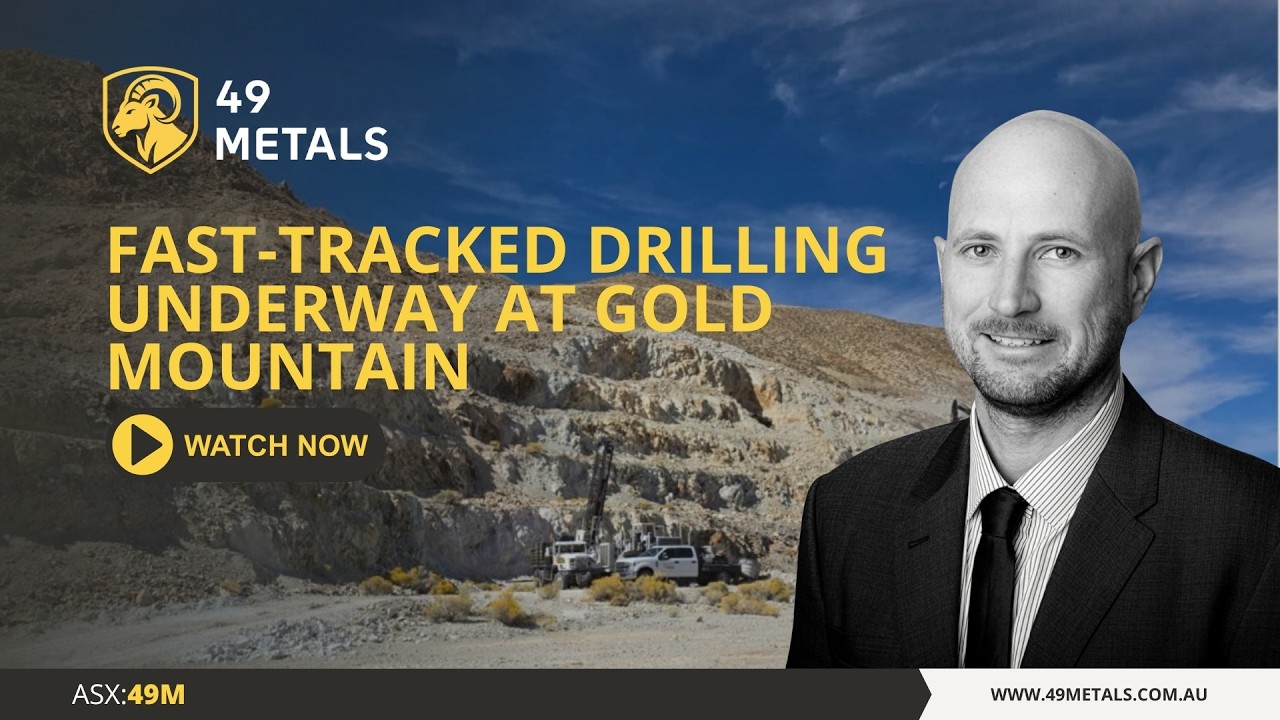
Back for Seconds... 49 Metals Puts the Rig to Work at Gold Mountain
When your first round of drilling hits gold in every single hole, you don't hang about. 49 Metals has fast-tracked its follow-up program at the flagship Gold Mountain Project in Nevada's Walker Lane Trend, and the rig is turning again.
The goal is simple: find out how big the Adit Zone discovery really is.
The Rig's Back in Town
The new RC program is fully funded. It covers about 3,500m across 10–11 holes, all aimed at the Adit Zone, which is still open along strike and down dip. The drilling has four jobs:
Step out along the interpreted mineralised corridor to grow the footprint
Infill the existing pattern to firm up continuity and geometry
Work out how the higher-grade structures sit within the broader mineralised envelope
Collect the geological and structural data that will guide future resource evaluation
Managing Director Phil Carter said the maiden program "identified high-grade gold within a much broader mineralised system", and this round is about "testing how far the Adit Zone discovery extends."
Why the Fuss? A Quick Recap
The ~7,500m, 22-hole maiden program wrapped up earlier this year, and every hole returned gold and/or silver mineralisation. Not a bad strike rate. The standouts:
DRC#9 (the discovery hole): 27.4m @ 8.3g/t Au from 221.0m, including 9.1m @ 21.9g/t Au from 224.0m
DRC#19: 67.1m @ 1.7g/t Au from 169.2m, including 10.7m @ 8.4g/t Au and 3.0m @ 20.0g/t Au from 189.0m
DRC#22: 170.7m @ 0.9g/t Au from 121.9m, including 50.3m @ 1.2g/t Au from 207.3m. That's the thickest continuous gold intersection at Gold Mountain so far
DRC#16: 15.2m @ 2.4g/t Au from 268.2m, including 6.1m @ 5.0g/t Au from 274.3m
There's some shallow goodness too. DRC#21 hit 13.7m @ 2.9g/t Au from just 12.2m, and DRC#18 returned 29.0m @ 1.3g/t Au from 18.3m.
Scale and Grade
The real shift is in how the company sees the system. What looked like a handful of separate high-grade structures now looks like a broad mineralised system with multiple structurally controlled high-grade zones running through it.
The company thinks DRC#9 has hit a high-grade feeder zone sitting inside a much bigger lower-grade envelope. The Oddie Rhyolite has also emerged as a key host rock, and DRC#22's 170m intercept sits entirely within it. That gives the team a predictive geological model to target from, rather than just poking holes and hoping.
The Adit Zone is also only one prospect at Gold Mountain. Plenty of other mineralised structures across the project haven't been properly tested yet.
Cashed Up and Well Placed
49 Metals had $6.8m in cash at 30 June 2026, so the program is fully covered. It's working in Nevada, which topped the latest Fraser Institute rankings of the world's most attractive mining jurisdictions. Gold Mountain is one of three Walker Lane projects in the portfolio, alongside Buffalo Canyon and Sinter.
Big Picture / What's Next
The first assays should land about 4–6 weeks after drilling started, subject to lab turnaround, and more will follow progressively after that. Shareholders should keep an eye on two things. First, whether the step-outs keep growing the Adit Zone footprint. Second, whether the infill holes show the high-grade structures are continuous. That second one is the bridge between a discovery story and a resource story.
The maiden program showed there's gold. This round is about showing there's a lot of it.
Looks like Gold Mountain is well and truly on the rise... and 49 Metals is just getting its second wind.
ASX:FAU | October 2026
First Au
Ida Like Some More Gold, Please
First Au has signed up the Ida Valley Gold Project, bringing a substantial historical drilling database and a direct line of sight to a maiden JORC resource. Meanwhile the rig is turning at First Hit and Lady Jane is joining the Riverina East family.
Two Deals and a Drill Rig
First Au isn't sitting still. In the space of a fortnight it has signed a deal for Lady Jane, put a rig on First Hit and now agreed to buy the Ida Valley Gold Project from TechGen Metals (ASX: TG1). The common thread? Buying ground where a lot of the early legwork has already been done... and then getting on with it.
Ida Valley: Data Rich, Ready to Validate
The latest move is a binding agreement to acquire two Exploration Licences in Western Australia's emerging Ida Fault gold district:
E 29/1053, home to the Ida Valley prospect
E 36/1015, home to the Pinnacles prospect
The real prize here is the homework that comes with it. Both prospects have been extensively drilled, and the deal includes a substantial historical drilling database. That puts First Au well ahead of a greenfields start. Following completion, the plan is a systematic validation and review of that data, with the objective of defining a maiden JORC-compliant Mineral Resource as efficiently and cost-effectively as possible.
Geologically, the project sits on the Ballard Fault, close to where it converges with the Ida Fault, within successions of komatiite and porphyry units with metamorphosed sedimentary inclusions following a north-westerly strike. Classic Archean greenstone country, and it slots in near First Au's Sandstone Project on the portfolio map.
A Deal That Won't Break the Bank
The price tag is modest:
A$100,000 cash, already paid as an exclusivity fee
A$100,000 in FAU shares, priced on the 15-trading-day VWAP prior to completion
The share issue needs shareholder approval under Listing Rule 7.1 at an upcoming general meeting, and completion also requires regulatory and third-party approvals, including any ministerial consents. Completion is expected shortly after the general meeting.
Executive Chairman Daniel Raihani said the acquisition “continues the Company’s strategy to further build and develop our existing project hubs with strategically placed acquisitions,” adding that “Ida Valley attracted us due to its relatively well-progressed exploration activity and strong potential for further development.”
First Hit: The Rig Is Turning
Over at the Riverina East Gold Project, a maiden RC drill program commenced in early October at the historic First Hit Gold Mine. It's chasing the depth extension of a mine that produced around 30,000 ounces at roughly 7.7g/t gold in only 15 months of production. That's a short, sharp, high-grade history worth following down.
The program was expected to take about two weeks, with assays due within the quarter. First Au has also commissioned an independent Perth-based consultancy to complete a maiden Mineral Resource Estimate incorporating results from this drilling. First Hit sits on granted Mining Licences, about 8km north of Ora Banda Mining's Riverina underground operation and 40km from the Davyhurst processing facility.
Lady Jane Joins the Family
At the start of October, First Au signed a binding agreement to acquire the Lady Jane Project from Dynamic Metals (ASX: DYM). That's six Exploration Licences in the Ora Banda district, sitting directly south of Riverina East at the convergence of the Zuleika Shear and Ida Fault, the same structural setting that hosts Ora Banda Mining's Riverina and Sand King underground mines.
The structure is light on upfront cash:
A$50,000 on execution and A$100,000 on completion
A$500,000 deferred to the completion anniversary, in FAU shares or cash at DYM's election
A 1.5% gross revenue royalty
A minimum A$250,000 drilling commitment within 24 months of completion
DYM's recent soil sampling and geological mapping hand First Au a ready-made dataset to start targeting from.
Why it matters
First Au is building a WA gold portfolio around one simple idea: buy projects where existing drilling and data can shortcut the path to a resource. Ida Valley is the clearest example yet. A big historical database, a low-cost entry and a defined validation program make for a capital-efficient way to chase a maiden JORC resource.
What to watch
First Hit assays, expected within the quarter
The maiden First Hit Mineral Resource Estimate
The general meeting to approve the Ida Valley consideration shares, followed by completion
Validation of the historical Ida Valley and Pinnacles drilling data
Completion of Lady Jane and first on-ground work across the expanded Riverina tenure
Looks like all roads lead to Ida... and First Au has the map.
ASX:FRS | October 2026
Forrestania Resources
Ounce Upon a Time at Tampia
Three resource updates in a fortnight. Tampia returns with a maiden 223,300oz, British Hill pushes past 212,000oz and The Ladies firm up their higher-confidence ounces.
Edna May's Pantry Is Filling Up
Owning a mill is one thing. Feeding it is another. With Edna May now in the bag and Lake Johnston being refurbished, Forrestania has spent the past few weeks doing exactly what a two-hub developer needs to do... stacking up ounces within trucking distance of its plants.
Three Mineral Resource updates landed between late September and early October, and the Zenith takeover has cleared its disclosure hurdle. For a company that only completed Edna May on 4 September, it has been a busy month.
Tampia Makes a Comeback
The headline act is a maiden JORC Mineral Resource for Tampia of 4.6 million tonnes at 1.50g/t gold for 223,300 ounces, at a 0.5g/t cut-off. More than half of that sits in the Indicated category:
Indicated: 2.5Mt at 1.47g/t for 118,500oz
Inferred: 2.1Mt at 1.56g/t for 104,800oz
Tampia isn't a new name. Ramelius mined about 3.0 million tonnes at 2.1g/t for roughly 201,100 ounces from the open pit between 2021 and 2023, trucking the ore around 140km to... you guessed it, Edna May. When mining finished, the remaining in-situ resource beneath the pit was dropped from Ramelius' inventory. Forrestania picked up the project from Ramelius in September and has now put those ounces back on the books.
The estimate draws on more than 180km of drilling across 4,496 holes, and the pit shell was optimised at A$6,000/oz assuming processing at Edna May. Historical testwork showed oxide recoveries above 96% and fresh ore averaging 91.4%. Tampia sits on granted Mining Lease M70/816, about 75km south of Merredin, inside the newly acquired Westonia Hub.
Chairman David Geraghty said the estimate provides “additional Mineral Resource ounces within trucking distance of the Edna May processing facility.”
British Hill Keeps Climbing
British Hill has had back-to-back upgrades. One month after the August estimate of 175,690 ounces, the 24 September update lifted the resource 21% to 4.12 million tonnes at 1.60g/t gold for 212,400 ounces, at a 0.5g/t cut-off.
The better news is in the confidence. Indicated Resources rose 37% to 2.65 million tonnes at 1.62g/t for 138,100 ounces, now more than half the total. The update added 15 RC holes for 3,685 metres, and three RC rigs plus a diamond rig are still drilling along strike and down dip.
Preliminary metallurgical testwork returned gold recoveries of 83.9% to 91.4%, with 40% to 42% gravity recoverable. British Hill sits about 145km by road from Edna May, with further metallurgical, environmental and approvals work still required before any mining decision.
The Ladies Trade Size for Confidence
At the Forrestania Hub, Lady Ada and Lady Magdalene (The Ladies) were re-estimated at 4.89 million tonnes at 1.82g/t gold for 285,700 ounces. Total ounces dipped 4% on re-estimation, but Measured and Indicated ounces rose 43% from the May estimate:
Measured: 0.16Mt at 3.04g/t for 15,400oz
Indicated: 1.53Mt at 1.73g/t for 85,000oz
Inferred: 3.20Mt at 1.80g/t for 185,300oz
Lady Ada has form. Sons of Gwalia mined it as Blue Haze in 2002 and 2003, producing 95,865 tonnes at 8.81g/t for 27,154 ounces, and earlier testwork returned recoveries of 97% to 99%. The resource assumes processing at Lake Johnston, about 105km by road. One to note: the deposits are subject to a legal dispute with Classic Minerals, and Forrestania maintains its position and title.
Zenith: Back On Track
The Zenith takeover has cleared a key hurdle. Following Takeovers Panel orders made on 17 September, Forrestania lodged a corrective supplementary bidder's statement and historical substantial holder notice on 13 October, and is now dispatching them to Zenith shareholders.
The offer is open until 12 November (unless extended), and Forrestania already holds a relevant interest in 58.61% of Zenith. It intends to declare the bid unconditional as soon as it can, which can't happen until one week after dispatch is complete. Accepting Zenith shareholders would then receive Forrestania shares within 14 days.
Executive Chairman David Geraghty said the best home for Zenith's Consolidated Dulcie Project is “within Forrestania,” describing the offer as a chance to swap into “a company on the precipice of commencing its own gold production.”
The Platform Underneath
All of this sits on the platform built in August and September. The Edna May acquisition, funded by the A$310 million institutional placement, brought a 2.9Mtpa processing plant (on care and maintenance since April 2025), a 185-room village and supporting infrastructure. Lake Johnston refurbishment has progressed across the grinding and elution circuits and CIL tank installation.
The supply chain is also falling into place. MEGA Resources holds a ~A$27 million, seven-month Stage 1 contract at Tycho alongside the two-year Johnson Range contract (~A$145 million base value). Forrestania also has a laboratory framework with SGS, a Campbell Gold Haulage agreement, a five-year Orica cyanide contract for Lake Johnston from 2027, and long-lead consumables on order for Edna May. A First Au ore purchase framework allows for up to two million tonnes of suitable ore over an initial 24 months, subject to conditions. That is potential feed, not a locked-in schedule.
Why it matters
A mill without ore is just expensive scrap metal. Tampia and British Hill both assume processing at Edna May, and The Ladies assume Lake Johnston, so these updates directly address the biggest question hanging over the two-hub strategy: what goes through the plants? The shift towards higher-confidence Indicated ounces matters too, because that's the material that can eventually be converted to Ore Reserves. None of these are reserves yet, and a healthy share is still Inferred.
What to watch
Ongoing British Hill drilling and the next resource update
Validation work and mine planning at Tampia
Dispatch of Zenith documents, the bid being declared unconditional and the 12 November close
Lake Johnston commissioning milestones and Edna May restart planning
Mining start-up at Tycho and Johnson Range
Progress in The Ladies legal dispute
Forrestania's pantry is filling up nicely... now it's time to start cooking.
ASX:HTM | October 2026
High-Tech Metals
To Infinity and Beyond Discovery
New board, new register and soon a new name. High-Tech Metals has handed the keys to a fresh leadership team led by Cristian Moreno and proposes to become Beyond Discovery Limited.
New Crew, New Name, Same Gold
Some companies tweak the strategy. High-Tech Metals has refreshed the board, reset the register and proposed a new name, all within a few days.
The gold underneath hasn't changed. The Mt Fisher and Mt Eureka projects still hold 202,000 ounces across about 1,150km² of WA's Northern Goldfields. What's changed is who is driving, and how hard they intend to push towards production.
All Change in the Boardroom
Effective 6 October, three new directors joined the board:
Cristian Moreno, appointed Executive Director. He most recently led Torque Metals, where he delivered exploration success, resource growth and strategic acquisitions, culminating in a transaction with the former Spartan Resources leadership team.
Patrick Burke, appointed Non-Executive Chairman. A lawyer with more than 20 years of corporate advisory and legal experience, he is a former director of Meteoric Resources and Vulcan Energy Resources.
Michael McNeilly, appointed Non-Executive Director. CEO of Strata Investment Holdings and a former Non-Executive Director of Greatland Gold, he brings deep capital markets experience.
Outgoing Chairman Charles Thomas and Non-Executive Director Tyler Formica have retired from the board, while Quinton Meyers stays on as Non-Executive Director and Company Secretary.
Moreno has also put his money where his mouth is, buying 143,349 HTM shares on-market on 7 and 8 October for about A$38,000.
“Our focus is clear,” Moreno said: “deliver the Wagtail Scoping Study, generate early cash flow from the Mt Fisher stockpiles, and systematically unlock the gold potential of a 1,150 km² landholding that has barely been tested.”
Paid to Hit the Targets
Subject to shareholder approval at the November AGM, the incoming directors will receive up to 17.1 million performance rights. These only vest if the company grows its resource or its share price grows:
Resource of at least 350,000oz across the existing tenements
Share price VWAP of at least A$0.40 over 20 consecutive trading days
Share price VWAP of at least A$0.60 over 20 consecutive trading days
Resource of at least 600,000oz across the existing tenements
In other words, nearly tripling the current resource, or more than doubling the A$0.25 reference price used in the announcement. Ambitious targets, but that's the point.
Register Reset
Alongside the board changes, a Special Crossing through Euroz Hartleys will see 12,486,837 shares (about 11.9% of issued capital) move from existing holders to new and existing long-term supporters of the incoming directors. It's designed to remove a potential share overhang and line the register up behind the new strategy. No new shares are being issued, so there's no change to issued capital or cash.
Beyond Discovery... Literally
On 8 October, High-Tech announced it will seek shareholder approval to change its name to Beyond Discovery Limited, with the proposed ASX code BYD (subject to ASX confirmation). The new name reflects the refreshed board's strategy to move beyond discovery and advance Mt Fisher and Mt Eureka towards development.
The resolution goes to the AGM proposed for Friday, 27 November, and needs at least 75% of votes cast. It's a change of identity only, with no change to the projects, assets, operations or capital structure.
The Ounces Behind the Ambition
The 31 August update lifted the Mt Fisher resource 47% to 800,000 tonnes at 2.0g/t for 51,000 ounces, after 6,038 metres of Phase 1 drilling confirmed mineralisation beneath the historic pit and beyond the old resource envelope. Across both projects, the combined resource now stands at 3.9 million tonnes at 1.61g/t for 202,000 ounces:
Mt Fisher: 51koz at 2.0g/t
Damsel: 75koz at 1.66g/t
Wagtail: 13koz at 3.8g/t
Southern: 38koz at 1.25g/t
Taipan: 25koz at 1.21g/t
Metallurgical testwork has shown free-milling, non-refractory gold with recoveries of up to about 97% using conventional gravity and leach processing. Four new gradient-array IP targets at Mt Eureka South give the next round of drilling plenty to aim at.
A Non-Dilutive Path to First Gold
The production pathway is what sets HTM apart. Under its binding mining and profit-share arrangements with SSH Group (ASX: SSH), SSH funds key pre-development activities and, subject to a final investment decision, mining at Wagtail. The Mt Fisher stockpiles offer a chance at early cash flow. A non-binding MOU with Wiluna Mining covers potential processing of HTM ore.
All of this sits on a tight structure: 105.3 million shares on issue, about A$9 million in cash, and a market capitalisation of roughly A$26.33 million at A$0.25 for an enterprise value of around A$17.33 million.
Why it matters
For a company with 202,000 ounces, about A$9 million in cash and a partner-funded route to Wagtail, the missing piece was a team with the mandate and incentives to accelerate. That's what has just arrived. The performance rights tie the board's rewards directly to resource growth and share price, and the Special Crossing gives it a supportive register. The MOU with Wiluna remains non-binding, and Wagtail mining depends on a final investment decision.
What to watch
The Wagtail Scoping Study
Potential processing of the Mt Fisher stockpiles
The AGM on 27 November: name change to Beyond Discovery and director performance rights
Further drilling at Mt Fisher and testing of the Mt Eureka South IP targets
Progress on processing arrangements
High-Tech Metals is about to go Beyond Discovery... and if the new crew delivers, shareholders might just go beyond expectations.
Cu
Copper & Base Metals
3 companies
ASX:ANX | October 2026
Anax Metals
Whim Creek Strikes Where It Counts
Mons Cupri's infill drilling has delivered bonanza copper-equivalent grades from just 35 metres downhole, confirming the high-grade heart of the restart plan. With FEED underway, a heap-leach feasibility study in progress, and a DHEM crew about to hit site, Anax is building momentum on every front ahead of a targeted late-2026 investment decision.
You can have all the studies and spreadsheets you like... but at some point, the rocks have to deliver. At Mons Cupri, they just did.
Bonanza Grades from the First Holes
The first assays from Anax’s 5,000-metre diamond drilling campaign at Mons Cupri have produced exceptional results, with high-grade copper-equivalent mineralisation starting from just 34.60 metres downhole.
The standout intercepts:
85.90m at 2.89% CuEq from 34.60m (26ANXDD001), including 4.70m at 8.34% CuEq and 17.50m at 8.37% CuEq
62.54m at 2.95% CuEq from 107.32m (26ANXDD003), including 5.04m at 5.46% CuEq and 18.98m at 6.01% CuEq
Those high-grade zones of more than 8% CuEq aren’t deep, hard-to-reach mineralisation. This is the material scheduled to be mined in the early stages of the restart plan, which is exactly the kind of grade profile that underpins strong early cashflow.
Significant silver and gold by-product credits were also noted within the upper portions of the main Mons Cupri lens, adding further upside to the copper-zinc story. Results from the remaining six holes (26ANXDD005A to 26ANXDD010) are pending.
The Drill Bit Keeps Turning
As at mid-September, Anax had completed 10 holes for 2,736 metres out of the planned 5,000-metre programme. Four holes targeted Mons Cupri for metallurgical and infill purposes, with six exploration holes stepping out across the western corridor. All holes have successfully intercepted the host stratigraphic package.
Geophysical consultant Newexco has reviewed historic DHEM surveys from 14 diamond holes drilled in 2004-05 and confirmed that copper-zinc mineralisation does produce a genuine electromagnetic response, but that vintage equipment limited how clearly it could be resolved. Modern DHEM technology offers significantly improved sensitivity. A DHEM crew is mobilising to site in late September, with the 2026 campaign focused on the western side of Mons Cupri, following the plunge of the main shoot and the structural corridor linking to the north-western shoots.
Drilling is scheduled to continue through the December quarter, with additional holes designed to follow up IP targets historically correlated with sulphide mineralisation but poorly tested. A broad project-wide target evaluation using Aster and World3 satellite imagery is also underway.
A Bigger Mons Cupri to Build On
The drilling results support the updated Mons Cupri Mineral Resource released in August: 6.32 million tonnes at 1.38% CuEq (100% project basis), using a 0.50% CuEq cut-off. Tonnes increased 24% and contained CuEq metal rose 20% to 87,200 tonnes. Measured and Indicated material accounts for more than 78%, at 4.95 million tonnes grading 1.50% CuEq. Anax owns 80% of the project, with Develop Global holding the remaining 20%.
The revised estimate incorporates updated interpretation and reporting assumptions, so the uplift should not be read simply as newly discovered metal. The resource will inform Ore Reserve work targeted for the December quarter; conversion into a reserve is not assured.
Backed to Push Ahead
A A$6 million placement was announced to support exploration around Whim Creek, with backing from institutional, professional and sophisticated investors. The funds are earmarked for an aggressive exploration campaign designed to unlock additional value around the project. Project financing remains a separate workstream. The February DFS update described non-binding indicative debt and offtake proposals of up to A$57 million. These proposals do not amount to committed or drawn project finance.
Engineering and Team in Place
Front-End Engineering Design commenced on 27 July, increasing engineering definition across the proposed 400,000 tonne-per-annum concentrator, ore sorting and pre-concentration circuits, mining fleet and supporting infrastructure. Experienced mining executive Danny George joined as Chief Operating Officer, bringing more than two decades of international project delivery experience across copper, base metals and critical minerals.
The project concept also retains a refurbished heap-leach route for suitable oxide, transitional and supergene material. A separate Feasibility Study into heap-leach processing commenced on 3 September, expected to be completed in the March 2027 quarter. Larger-scale CSIRO column tests achieved copper extraction of 77-80% and zinc extraction above 90% from lower-grade ores. Heap leaching is being assessed as an additional processing route, not a replacement for the concentrator.
The Economics Behind the Engineering
The 24 February DFS update provides the financial reference point: a pre-tax, pre-finance NPV of A$501 million at a 7% real discount rate, a 98% IRR and A$723 million in forecast free cash flow. The approximately A$91 million development requirement includes A$77 million of pre-production capital and A$14 million of working capital, with around 14 months’ payback. These figures are on a 100% project basis.
The base case assumes copper at US$11,500/t, zinc at US$3,000/t, lead at US$2,000/t, silver at US$70/oz, gold at US$4,500/oz and US$0.68 per Australian dollar. It models a ten-year operation; underground components are at pre-feasibility level. Commodity prices, costs, funding and execution can change the outcome. Its production target comprises 94% Ore Reserves and 6% Inferred Resources; the latter have low geological confidence and conversion is uncertain.
What’s Next
The bonanza infill results confirm the grade at Mons Cupri isn’t just a model, it’s in the core trays. With DHEM about to start, more assays pending, reserve work underway, FEED progressing and project financing advancing, the milestones are stacking up ahead of a targeted late-2026 investment decision.
All Anax needs now is for the rest of the holes to be as well behaved as the first four.
With grades like these, the Whim Creek restart is looking a lot less like a whim and a lot more like a plan.
ASX:10X | October 2026
Exultant Mining
The Dragon Waits on the Lab
Balerion's six-hole maiden program is complete, with sulphides logged in five holes and assays for the last three still with the lab. Black Hammer now has three undrilled copper-gold targets lined up behind it.
Black Hammer Gets Its Targets, Balerion Awaits Its Numbers
Exultant Mining spent August drilling and September sharpening. The maiden Balerion program in NSW finished with visible sulphides in five of six holes, and the Company used the wait for assays to narrow its 390km² Black Hammer tenure down to three priority copper-gold targets.
Black Hammer names its priorities
Exultant selected Watsons, Porters Retreat and Vermithor as priority targets across the 100%-owned Black Hammer Project in the Macquarie Arc. Watsons carries a coherent 2.4-kilometre copper-zinc soil anomaly, open to the north and south. It has never been drill tested or assayed for gold, and sits about two kilometres along strike from historical gold mines. Fieldwork has started there.
Porters Retreat is an altered, sulphide-bearing monzonitic intrusive system with chalcopyrite at surface, prospective for porphyry or epithermal gold-copper. Vermithor is a newly defined one-kilometre by one-kilometre remanent magnetic anomaly with no historical follow-up. All three are undrilled. The plan is staged, capital-efficient surface work, geochemistry and geophysics before the Company commits drilling dollars.
Balerion's final hole
The final hole, BLRCDD006, intersected an approximately 6.5-metre down-hole shear zone, including a 3.25-metre talc-rich interval from 189.4 metres with visually estimated heavy disseminated to locally massive sphalerite, galena and pyrite. It tested an IP chargeability anomaly about 100 metres up-dip of BLRCDD005, which had logged an 11.5-metre apparent shear interval. The comparison suggests the shear system may thicken down-dip, an idea the assays and modelling now need to test.
That completed a six-hole, 1,370.3-metre maiden program, delivered on budget, with visible sulphides in five of the six holes.
Finding the contact
Earlier, BLRCDD004 and BLRCDD005 intersected the targeted sheared rhyolite-volcaniclastic contact with visible sphalerite, galena, chalcopyrite and pyrite, with BLRCDD005 showing the stronger sulphide development. The holes tested resistivity-low anomalies roughly 190 and 220 metres down-dip of historical high-grade holes, including PVI008, which returned 0.8 metres at 22.0% Zn, 11.6% Pb, 1.2% Cu and 155g/t Ag. Assays from the first two holes had confirmed base-metal and silver anomalism.
The caveat that matters most
Every Balerion observation above is visual. Visual sulphide estimates are not assays and cannot establish grade, true width, continuity or economic significance, and apparent down-hole thicknesses are not true widths. Laboratory results for BLRCDD004, 005 and 006 were still outstanding at the end of September.
Why it matters
Black Hammer is where the Exultant story broadens. The Company holds 390km² of 100%-owned tenure in the Macquarie Arc and has ranked it down to three undrilled copper-gold targets, each a different style: a 2.4-kilometre copper-zinc soil anomaly at Watsons that is open to the north and south and has never been assayed for gold, an altered intrusive system with chalcopyrite at surface at Porters Retreat, and a newly defined magnetic anomaly at Vermithor. The staged, surface-first approach sharpens those targets before drilling dollars are committed, with Balerion assays providing a parallel data point.
What to watch
Balerion assays for holes 4 to 6 and the updated geological model that follows, first-pass mapping and sampling results from Watsons, and how Exultant ranks Porters Retreat and Vermithor for drilling. The AGM is scheduled for 13 November.
Balerion’s assays are still in the lab, but every Westeros fan knows the golden rule: never rush a dragon.
ASX:MMA | October 2026
Maronan Metals
Silver Linings, Now With Copper Trim
Maronan's September drilling delivered 11 metres at 10.3% lead and 116g/t silver, plus shallow copper-gold north of the Indicated resource. With more than 15,000 metres of a 40,000-metre program complete and a project builder arriving as MD, the PFS pieces are moving.
Maronan Metals' 40,000-metre infill program is starting to show what it can do. September delivered high-grade silver-lead from the Western and Eastern Horizons, shallow copper-gold north of the Indicated resource, and a new Managing Director with 30 years of project-delivery experience.
Infill keeps delivering
The standout from the latest batch was MRN26013 on the Western Horizon: 11.0 metres (8.5 metres estimated true width) at 10.3% lead and 116g/t silver from 351 metres, including 4.1 metres at 17.0% lead and 220g/t silver. On the Eastern Horizon, MRN26015 returned 6.8 metres (5.6 metres etw) at 7.1% lead and 211g/t silver from 277 metres, and MRN26013 added a silver-rich 2.0 metres (1.6 metres etw) at 4.2% lead and 533g/t silver from 491.4 metres. MRN26015 also returned 12.2 metres (9.3 metres etw) at 9.4% lead and 49g/t silver from 128 metres, although that interval includes 3 metres of core loss and partially oxidised material. The holes are drilling into Inferred areas and extensions of the 2025 Indicated resource. They refine the geological model; they are not a new resource estimate.
Copper-gold shows up north
Maronan also reported shallow copper-gold mineralisation north of its 2025 Indicated copper-gold resource. MRN26008 returned 20.0 metres (17.4 metres etw) at 0.83% copper and 0.42g/t gold from 257 metres, including 4.5 metres at 1.50% copper and 0.68g/t gold. MRN26004 returned 8.9 metres (7.6 metres etw) at 1.03% copper and 0.61g/t gold from 297.1 metres, and 12.0 metres (10.3 metres etw) at 0.86% copper and 0.88g/t gold from 339 metres.
MRN26008 also hit 4.0 metres at 0.96% copper from 356 metres in a massive pyrrhotite zone where copper had not previously been identified, which requires follow-up drilling. Some intervals include core loss. For context, the existing copper-gold resource is 32Mt at 0.85% copper, 0.63g/t gold and 7g/t silver across the Indicated and Inferred categories.
A project builder takes the chair
On 7 September, Maronan appointed Andrew Graham as Managing Director and CEO, commencing on 23 November 2026. Graham brings around 30 years of underground base and precious metals project-delivery experience, including Dugald River. Richard Carlton will remain on the board as a Non-Executive Director after the handover.
Why it matters
Maronan reports estimated true widths alongside down-hole lengths, so the infill results can be benchmarked directly. Silver-lead carries the development story, while the copper-gold result underlines that Maronan is a two-system project. Appointing a project builder ahead of the PFS signals where the board is taking the project. The infill program's job now is to convert Inferred material into Indicated.
What to watch
More than 15,000 metres of the 40,000-metre program was complete at the 17 September release, so further infill batches should follow. Beyond that: the resource review and update, the PFS targeted for mid-2027, Andrew Graham's start in November and the AGM on 4 November.
Silver-lead in the lead role, copper-gold in support... Maronan’s cast is coming together nicely. Every cloud, right?
Li
Critical Minerals
7 companies
ASX:DLY | October 2026
Daly Resources
Bigger Than It Looks
New soil and rock-chip results show Huckitta's fluorite system extends well beyond visible outcrop, expanding the target area east and west. A regional soil survey will now map the full system ahead of Daly's maiden drilling campaign, while Broughton and Batten continue to advance.
When you can see fluorite veins at surface, you know something’s there. The real question is how far the system goes where you can’t see it. At Huckitta, the answer appears to be: a lot further than anyone previously thought.
Soils Reveal What Outcrop Can’t
Results from a 10.7-kilometre northern soil traverse at Huckitta have defined multiple coherent fluorine-in-soil anomalies that extend well beyond the limits of known fluorite outcrop, including through areas of transported cover where no veins are visible at surface.
The traverse sits approximately 1.3 kilometres north of the main cluster of known fluorite veins and extends east beyond the limits of previously sampled outcrop on Daly’s tenure. Several of the fluorine anomalies are accompanied by elevated thorium and an associated geochemical suite including tin, niobium, tungsten, rubidium and beryllium, interpreted as the broader footprint of an evolved, fluorine-rich hydrothermal system.
New anomalous zones toward the eastern end of the traverse represent high-priority areas for follow-up exploration. The soil results don’t directly prove fluorite is sitting beneath every anomaly, but they’re proving to be an effective targeting tool for tracing the system under cover.
Growing in Both Directions
The latest round of rock-chip sampling has also identified a further fluorite-bearing vein to the west of the previously defined Priority Target Area, extending confirmed fluorite-bearing geology into an area not previously recognised as part of the principal target footprint. Combined with earlier results, including western-vein rock chips grading up to 91.2% CaF₂ from a mapped vein extending more than 700 metres (reported in July), and eastern outcrop samples up to 73.98% CaF₂ (reported in August), the picture of Huckitta keeps expanding. Rock chips from this latest round returned values up to 74.2% CaF₂ from the western target area and up to 50.1% CaF₂ from the eastern area.
These are selected surface samples across mapped occurrences, not a continuously assayed vein or a Mineral Resource. But the system is clearly getting bigger with each round of work.
What Comes Next at Huckitta
With soil geochemistry now validated as a targeting tool, Daly will undertake a systematic regional soil survey grid across the entire prospective basement geology within its tenure. The results will be integrated with recently completed high-resolution magnetic and radiometric surveys to build a comprehensive picture of the structural controls on fluorite mineralisation.
The objective is to identify areas where multiple fluorite-bearing veins may be concentrated or stacked within favourable structures, with evidence of continuity along strike. That integrated dataset will rank the highest-priority targets ahead of the maiden drilling campaign.
Three Projects, Three Fronts
Beyond Huckitta, the other two NT projects continue to advance. At Broughton, a 2,018 line-kilometre VTEM survey commenced in late August, screening for conductive copper-zinc targets across two blocks with 400-metre flight-line spacing (supported by A$150,000 in government co-funding). At Batten, soil sampling commenced in early September at the Hot Spring zinc target, testing the western continuation of the Bald Hills Fault trend to refine targets before future diamond drilling.
Huckitta sits immediately adjacent to Tivan’s Sandover Fluorite Project and shares similar geological characteristics, placing Daly in an increasingly recognised fluorite province. The Huckitta Project also hosts significant sedimentary-hosted copper potential, providing a second commodity avenue alongside the Company’s broader copper and zinc portfolio.
Well Funded for Discovery
Daly listed with a successful $12 million IPO, a tightly held register anchored by major shareholder Sandfire Resources, and more than 6,500km² of granted, 100%-owned Northern Territory tenure across its three projects. The IPO provided funds to begin the planned exploration program; field results and follow-up costs will determine how far that runway extends.
The Big Picture
Three months after listing, Daly has gone from mapping what it can see to proving that the system extends well beyond what’s visible. That’s a meaningful step for a fluorite explorer: the question is no longer just “is it there?” but “how big is it?”
The regional soil survey and integration with geophysical data will be the next major milestone. If the broader system shows the same kind of grade and continuity that the surface sampling has hinted at, the maiden drilling campaign could be targeting something with genuine scale.
Not bad for three months on the boards. Huckitta is a fluor-bomb about to explode!.
ASX:OD6 | October 2026
OD6 Metals
Cashed Up and Ready to Spar
A ~A$6.9m placement backed by global institutions, a 139-pad drill permit lodged, and a new high-grade zone linking Horseshoe to Big Jim. Plus a seat in the U.S. defence-industrial ecosystem and a new name that's Nevada spelt backwards.
When global institutions, family offices and professional investors queue up for a fluorspar junior... the market is telling you something. OD6 has firm commitments for about A$6.9 million in a single-tranche placement at 9.5 cents a share. The funds go straight to the Quinn work program:
Maiden drilling and bulk sampling, once U.S. Forest Service approval lands
Assaying, metallurgy (including ore sorting and beneficiation), geophysics and resource modelling
Progress towards a maiden JORC Mineral Resource
Managing Director Brett Hazelden called Quinn "remarkably under-drilled" despite the extensive high-grade fluorspar already found at surface. The balance sheet can now pay to test that properly.
A New Discovery Fills the Gap
OD6 has found high-grade fluorspar at North Horseshoe Canyon, with rock-chip assays up to 60% CaF₂ and further results of 57.3%, 51.0%, 21.4% and 18.5% CaF₂. Mineralisation outcrops over about 100m and remains open beneath cover. NHC sits about 450m northwest of Horseshoe, and the mineralised structure may run about 750m northeast beneath the lithocap towards Big Jim.
The Saw Mill Thrust only outcrops in two places, Big Jim and NHC, and both are mineralised. That turns Horseshoe, NHC and Big Jim/Spar into a 1.5km target corridor, not a scatter of isolated occurrences.
139 Drill Pads, One Big Permit
OD6 has lodged its maiden Plan of Operations with the U.S. Forest Service for up to 139 drill pads across Quinn. About 10,000m of priority 1 drilling is planned, with multiple holes possible from individual pads. The drilling is designed to build the geology, grade and continuity data a Mineral Resource needs. Bulk sampling will supply material for larger-scale ore sorting, beneficiation and metallurgical work.
Biological and cultural baseline field surveys are done, with final reports targeted for October 2026. OD6 is targeting a Categorical Exclusion pathway and has started talks about potential FAST-41 Transparency status. Now the money is in the bank, permitting is the main gate.
Clean Chemistry, Premium Potential
The earlier Quinn work is why investors are paying attention. Horseshoe averaged 70.9% CaF₂. Re-assays returned 50m at 79.3% CaF₂ and 15m at 85.8% CaF₂, with a top result of 98.8% CaF₂. Multi-element assays point to low impurities, which supports potential MetSpar and AcidSpar pathways. That still depends on continuity, metallurgy, permitting and economics. Ore sorting, flotation, dense-media separation and product validation work are underway.
Mammoth Gets Bigger
The Mammoth fluorspar target has grown by more than 50%. That widens the exploration canvas beyond Horseshoe and adds another area where mapping, sampling and drilling can test scale.
Uncle Sam Picks Up the Phone
OD6 has been accepted into the U.S. Defense Industrial Base Consortium. That puts Quinn inside a government-industry framework focused on critical materials, domestic processing and resilient supply chains. It matters because the U.S. is still 100% net import reliant for fluorspar. Membership gives access to applicable solicitations, teaming opportunities and strategic partnerships, building on OD6's SAM.gov registration. It's a pathway, not a cheque: no DIBC funding has been awarded.
Nevada, Backwards... Adaven, Forwards
OD6 plans to become Adaven Limited, subject to shareholder approval at the AGM, with the ticker expected to move to ADA, subject to ASX confirmation. The name is "Nevada" spelt in reverse, which says plenty about where the company's centre of gravity now sits. The Australian portfolio still comes along for the ride: rare earths at Splinter Rock in WA and copper at Gulf Creek in NSW.
The board has also put some skin in the game. Proposed director performance rights only vest on Quinn milestones. The bar starts at a JORC resource of at least 5Mt at 30% CaF₂ with 75%+ recovery, and rises to 10Mt at 30% CaF₂ and a Feasibility Study showing a post-tax IRR of at least 20%. That's a clear marker of what management is aiming for.
The Big Picture
In a matter of weeks, OD6 has found a zone that could connect its priority targets, lodged a drill permit to take Quinn from surface sampling to resource definition, joined the U.S. defence-industrial ecosystem, and now raised the cash to pay for it. The chemistry is clean, the grades are exceptional and the permitting work has been done early.
Here's what's coming:
USFS permitting milestones
Maiden drilling and bulk sampling
Metallurgical results
District-scale exploration and resource definition
More ANSTO testwork at Splinter Rock and next steps at Gulf Creek
Last time all that was missing was the drill bit turning. Now the money's in place too... it's just the paperwork standing between OD6 and the rig.
Funded, focused and soon to be renamed after the state it's betting on... OD6 is spar-ing no effort to make Quinn a fluorspar heavyweight.
ASX:RIM | October 2026
Rimfire Pacific Mining
Three Tests, One Question
Rimfire expanded its Murga scandium metallurgy to three parallel workstreams, with results cascading from October through November. Fresh capital and a refreshed leadership team now support the technical push.
Rimfire has expanded the Murga scandium metallurgical study to long-term bottle roll testing, column leaching and agitated tank leaching. The purpose is to determine whether Murga’s low-iron host rock can support a less complex and less capital-intensive atmospheric leaching route than HPAL. Data from all three streams will feed a desktop financial study.
The bottle roll update is targeted for early to mid-October 2026. A 40kg bulk sample has been sent to Electric Metals in the Philippines for two parallel column tests, with results expected by early November. A 10kg sample is being tested by Simulus Laboratories in Perth using heated agitated tank leaching, with results expected by late November.
Why Low Iron Matters
Murga’s host rock averages approximately 16% Fe, compared with about 34% Fe at Rio Tinto’s Burra deposit. Lower iron may mean lower acid consumption and a simpler processing route. Murga contains 11.9kt of contained scandium oxide, but the commercial case still depends on extraction, recovery, acid use and operating costs.
Ownership and Funding Shift
Rimfire raised A$2.3m at 0.8 cents per share and appointed Bronwyn Barnes as Executive Chair from 1 September. Directors and management committed A$580,000 to the placement. David Hutton moved to Technical Director to lead exploration, resource development and technical studies. The management changes matter, but the metallurgy remains the main event.
Read the Metallurgy with the Clarification Attached
Rimfire’s 13 August clarification to its June announcement is important context: early extraction behaviour from short-duration tests should not be treated as a final recovery outcome. The longer-duration and expanded testwork is the more meaningful evidence.
The Big Picture
Rimfire is building the evidence base needed to move Murga from interesting metallurgy towards a development case. Next catalysts are the bottle roll, column and tank leach results, followed by the desktop financial study. Sometimes the answer isn’t deeper… it’s broader.
Three tests at once, low iron and nothing wasted... Rimfire is likely to create investor scandimonium.
ASX:CNJ | October 2026
Conico
Greenland Gets Bigger on the Map
Conico has expanded the menu in East Greenland, applying for rare-earth and gold-PGE ground while keeping scandium work at Mt Thirsty in the domestic pipeline. The important word, for now, is “applications”.
The Story So Far
Conico’s latest period is best understood as portfolio positioning. In East Greenland, the Company lodged applications for the 862km² Kai rare-earth project and the 390km² Lilloise gold-PGE project.
Two Different Geological Ideas
Kai is centred on a large interpreted alkaline intrusive complex and is being pursued for rare-earth potential. Lilloise targets a layered ultramafic intrusive setting with gold and platinum-group-element potential. Subject to the applications being granted, Conico’s East Greenland position would increase to approximately 6,460km². That is meaningful scale, but it is not granted tenure, field validation or a discovery.
Mt Thirsty Stays in Frame
Closer to home, Conico continues planning a second phase of scandium-focused drilling at Mt Thirsty in Western Australia, providing a more advanced workstream while the Greenland applications move through the regulatory process.
The Journalist’s Lens
This is option-building. The next value-adding steps are licence grant, prioritisation, funding and field evidence. Until then, the new Greenland ground belongs in the potential column, not the proven one.
What to Watch
Kai and Lilloise licence grants, the design and timing of Mt Thirsty’s next scandium program, and any partnership or funding decisions.
Conico is keeping its Greenland options on ice for now... but up there, that’s just good storage.
ASX:ENR | October 2026
Encounter Resources
Aileron Turns Up the Grade, Parbo Turns Up the Copper
Encounter closed September with its best Green niobium hole yet, a new high-grade zone at Joyce and more than a kilometre of +0.4% copper oxide modelled at Parbo. With the copper assets under strategic review, that last result is more than a footnote.
Encounter Resources finished the quarter with news on both sides of its portfolio. Aileron in the West Arunta region delivered the Company's highest-grade Green intersection to date and a new high-grade zone at Joyce. Meanwhile, the Parbo copper system in WA's Paterson Province was modelled into large, shallow copper-oxide blankets while the copper assets sit under strategic review.
Parbo puts shape around the copper
Encounter built three-dimensional wireframes at +0.2% and +0.4% copper across the Parbo oxide system, part of the 100%-owned Yeneena Copper Project. The +0.4% Cu zones extend over more than one kilometre of strike, inside a broader +0.2% Cu envelope up to about 800 metres wide. Supporting intersections include 52 metres at 0.6% Cu from 42 metres, including 8 metres at 2.0% Cu (EPT1689), 26.6 metres at 0.6% Cu from 74.4 metres (EPT1159) and 15 metres at 1.0% Cu and 0.6% Co from 36 metres to end of hole (EPT1557).
Parbo sits on the same eight-kilometre McKay Fault corridor as the existing Tyrell Inferred Resource of 2.9Mt at 0.79% Cu. Samples have been collected for sighter leach testwork, and assays from diamond holes at Tyrell, Maitland and Griffin are expected in October. The wireframes are a geological interpretation to guide drilling. They are not a Mineral Resource or an Exploration Target.
Green's best hole yet
Aircore hole EAL1513 returned 51 metres at 5.0% Nb₂O₅ from 63 metres, including 13 metres at 10.4% Nb₂O₅ from 80 metres, within a broader 93 metres at 3.03% Nb₂O₅ from 48 metres. Encounter described it as its highest-grade result at Green. It sits on the deposit's northern margin, outside the current resource boundary.
That location is the point. Green's earlier drilling was on roughly 200-metre-spaced lines, and the 2026 program is designed to improve confidence and define potential high-grade starter-pit areas along the four-kilometre deposit. Intervals are down-hole lengths with true widths not yet known, and mineralisation outside the resource does not add resource tonnes until it has been drilled, modelled and estimated.
Joyce joins the conversation
Six kilometres east of Green, aircore drilling at Joyce returned 4 metres at 2.4% Nb₂O₅ from 40 metres to end of hole (EAL1692) and 6 metres at 1.3% Nb₂O₅ from 88 metres to end of hole (EAL1693), following a 2025 intersection of 9 metres at 2.2% Nb₂O₅. Encounter now interprets the Aileron carbonatite system over more than 18 kilometres of strike from Emily to Joyce. Assays from holes about 200 metres either side are pending to test lateral continuity.
August laid the groundwork
On 3 August, Emily aircore drilling returned 13 metres at 3.2% Nb₂O₅ from 39 metres to end of hole (EAL1993) and 15 metres at 2.4% from 44 metres to end of hole (EAL1995), while Green infill added 53 metres at 2.9% from 79 metres to end of hole (EAL1452). On 25 August, Green delivered 92.4 metres at 2.0% Nb₂O₅ from 74 metres, including 19.7 metres at 5.3% (EAL1370), and diamond drilling began at Emily to test depth and collect metallurgical samples. By then more than 40,000 metres had been drilled at Aileron in 2026, with about 30,000 metres still planned across three rigs. For reference, Aileron's Inferred Resource stands at 120Mt at 0.77% Nb₂O₅. Its high-grade component of 26Mt at 1.7% Nb₂O₅ is part of that total, not additional to it.
Copper under review, and still being drilled
On 20 August, Encounter commenced a strategic review of its WA and NT copper assets to assess alternative corporate structures and partnerships. Drilling continued regardless. A 6,000-metre diamond and RC program commenced at Jessica on 2 September, funded by South32 under the existing A$15 million farm-in, targeting sediment-hosted and IOCG-style copper across approximately 9,400km² east of Tennant Creek. A strategic review is not a transaction: no sale, joint venture or partnership has been agreed.
Leadership also changed from 1 September, with Will Robinson appointed Managing Director and CEO, Simon Hay moving to Non-Executive Chair and Jardee Kininmonth appointed Chief Development Officer.
Why it matters
Aileron is the development story. EAL1513 sits outside the current resource on Green's northern margin and, together with the new zone at Joyce, points to high-grade niobium extending beyond the existing resource footprint. That is significant for starter-pit definition, where shallow high grade can shape early mine planning. On the copper side, Parbo now has geological shape at scale, giving the strategic review a clearer picture of what the Yeneena portfolio could offer.
What to watch
October should bring more Joyce aircore results, the first Emily diamond results and the Tyrell, Maitland and Griffin diamond assays. After that: a regional Aileron aircore update targeted for November, Parbo leach testwork and any outcome from the copper strategic review.
Green, Joyce and Emily all pulling their weight, and Parbo in the hangar... this is one Aileron pointed firmly upwards.
ASX:MML | October 2026
McLaren Minerals
Broad, Shallow and Built for Scale
McLaren Minerals' 2026 Mineral Resource upgrade and expansion program has now returned assays from 371 holes across four batches. Every reported interval starts at surface, and no heavy mineral cut-off has been applied.
That gives a warts-and-all view of the full sampled profile, not cherry-picked high-grade slices. Batch averages have ranged from 4.00% to 5.44% HM, and the latest results again show the broad, consistent mineralisation that defines the deposit.
Managing Director Simon Finnis summed it up: "More of what we've come to expect from McLaren. Broad intervals, with good grades, all from surface."
The Latest: 57 Holes, Thick from the Top
The newest batch added 57 holes and 1,146 metres, at a length-weighted average of 4.00% HM over 20.1 metres. Thickness is the standout. 93% of holes returned at least 15 metres, 81% at least 18 metres and 46% at least 21 metres.
There's grade inside that profile too. Ten holes hit one-metre assays of at least 10% HM, led by 17.99% HM in MAC583 and 15.60% HM in MAC599. The best complete-hole results:
MAC625: 15m from surface at 6.88% HM (peak 11.82%)
MAC623: 18m at 5.87% HM (peak 11.06%)
MAC599: 20m at 5.69% HM (peak 15.60%)
MAC620: 21m at 5.53% HM
Nine holes combined at least 15 metres with an average of 5% HM or better. Finnis says those higher-grade pockets "will give us flexibility in the mine plan to ensure we give the project the best possible start."
Mid-September: 24 Metres at 7.54% HM
The 15 September batch covered 61 holes and 1,293 metres at 4.57% HM over 21.2 metres. MAC467 led the way with 24 metres from surface at 7.54% HM and a one-metre peak of 20.10% HM. MAC468 returned 13 metres at 7.25% HM and MAC532 returned 27 metres at 5.83% HM. 70% of holes averaged at least 4% HM.
The Highest Average So Far
The 1 September batch is still the grade benchmark: 74 holes and 1,199 metres at 5.44% HM over 16.2 metres. 89% of holes averaged at least 4% HM, 62% at least 5% and 32% at least 6%. Highlights included MAC435 (18 metres from surface at 8.06% HM) and MAC470 (21 metres at 7.61% HM), while MAC434 hit a one-metre peak of 16.43% HM.
The Biggest Batch
The program opened with its largest set of results: 179 holes and 2,835 metres at 4.96% HM over 15.8 metres, with 87% of holes averaging at least 4% HM. Representative intersections included 30 metres at 6.17% HM (MAC271), 27 metres at 6.51% HM (MAC273) and 27 metres at 6.44% HM (MAC412), all from surface.
Why It Matters
Mineral sands projects live and die on consistency and simplicity. In Finnis's words, McLaren is "a very consistent deposit, and a very straightforward deposit", which points to ease of mining at scale and a traditional processing flowsheet. More than 6,400 metres of complete sampled intervals across 371 holes, all from surface, is building the dataset that mine planners need.
The program is designed to lift confidence in the existing 529Mt Indicated and Inferred resource at 4.5% HM, and to feed Ore Reserve estimation and a Bankable Feasibility Study. These are assay results, not a new resource or reserve. Any development implications depend on the updated MRE, metallurgy and further studies.
McLaren has also completed the acquisition of the zircon-rich Barossa Project in South Australia, giving it a second mineral sands growth platform in the Eucla Basin.
What to Watch
The remaining 2026 assays, including step-out drilling results
The updated geological model and Mineral Resource Estimate
Metallurgical testwork and progress towards Ore Reserves and the BFS
The AGM on 23 November
Four batches, 371 holes, all from surface... McLaren's mineral sands keep piling up. Shore thing.
ASX:JLL | October 2026
Jindalee Lithium
Fired Up at McDermitt
Fire restrictions lifted, rigs turning. Jindalee's long-awaited Phase 1 drilling program is underway at McDermitt, feeding data into the Feasibility Study, while the US Elemental Nasdaq pathway stays on track for the second half of 2026.
After months of permits, paperwork and a little patience waiting out the fire season, the drill bit is finally doing the talking at McDermitt.
Jindalee has started its major Phase 1 drilling program at the 100%-owned McDermitt Lithium Project in southeast Oregon, one of the largest lithium resources in the United States. Meanwhile the corporate pathway to Nasdaq through US Elemental keeps moving in parallel. Technical substance and capital-market structure are now advancing together.
The Drill Bit Is Turning
Jindalee confirmed on 15 September that all major approvals were in place for Phase 1 drilling under the Exploration Plan of Operations approved by the Bureau of Land Management in December 2025. Once the BLM eased fire restrictions, the rigs went in.
RC and diamond rigs are now operating on site, starting with high-priority infill drilling in the central part of the deposit:
RC drilling: collecting hydrogeological data and installing monitoring wells for the
hydrogeological model
Diamond drilling: providing fresh core for geotechnical studies and metallurgical testwork
Phase 1 covers up to 100 drill sites within a staged 168-site program. This year's campaign targets about one-third of those approved Phase 1 sites and is expected to wrap up by the end of November, with first results due early in the March quarter of 2027.
Managing Director and CEO Ian Rodger said: “This program will provide critical data to feed into the McDermitt Feasibility Study and we look forward to providing further updates as results are received.”
A Resource Worth Upgrading
McDermitt already hosts a Mineral Resource of 3.0 billion tonnes at 1,340ppm lithium for 21.5 million tonnes of lithium carbonate equivalent (LCE), at a 1,000ppm cut-off. That splits roughly evenly between categories:
Indicated: 1,470Mt at 1,420ppm Li for 11.1Mt LCE
Inferred: 1,540Mt at 1,270ppm Li for 10.4Mt LCE
Part of the program's job is to support a potential upgrade in the classification of portions of that resource. For a project this size, moving ounces... sorry, tonnes... into higher confidence categories is what turns scale into bankability.
Preparing for Wall Street
The other big workstream is US Elemental, the proposed Nasdaq-listed vehicle that would own McDermitt, with Jindalee expected to retain a controlling interest of more than 80%. An amended Form S-4 was filed in August as the SEC process progressed, and the FY26 Annual Report states that the transaction “remains on track to close in the second half of 2026.”
If completed, the transaction is designed to:
provide direct access to US capital markets;
support a proposed US$20-30 million project funding round;
accelerate feasibility and development work; and
position McDermitt alongside America's growing critical minerals strategy.
Sometimes it pays to think globally... especially when your project already happens to be in the United States.
Backed to Build
Jindalee finished FY26 with about A$14.0 million in cash and listed securities, after completing roughly A$20.4 million of equity raisings during the year. The recent entitlement offer raised A$2.4 million, taking combined proceeds from the placement and rights issue to around A$11 million. That funds the drilling, metallurgical testwork, permitting and the US Elemental process.
Magnesium Earns a Supporting Role
Testwork announced in August produced magnesium oxide grading above 93% from a magnesium-bearing process stream at McDermitt, with a best result of 93.4% MgO and calciner conversion of up to 99.95%. It's proof of concept only, not a commercial by-product yet, and further engineering and commercial assessment are required. Still, a project that might one day offer two critical minerals from one process flowsheet is worth keeping an eye on. The fresh core from this drilling will feed into further metallurgical work.
Why it matters
The strongest version of the Jindalee story is a large US lithium project advancing on geology, processing and capital-market structure at the same time. The Nasdaq pathway could broaden access to US capital if completed. The drilling now underway supplies the technical substance behind it, with infill, hydrogeology and geotechnical data all feeding the Feasibility Study. Completion of the US Elemental transaction remains subject to conditions, including the SEC process.
What to watch
Completion of the 2026 drilling program, expected by the end of November
First Phase 1 results, expected early in the March quarter 2027
Further SEC milestones and shareholder approvals for the US Elemental transaction
Further magnesium and lithium metallurgical testwork using fresh core
Progress on the McDermitt Feasibility Study
Sometimes it's not simply about striking the right element... it's about putting it in the right market. And now, finally, putting a drill rig on it.
Tech
Technology
2 companies
ASX:RNT | October 2026
Rent.com.au
Moving in the Right Direction
Record FY26 revenue of A$4.42 million, up 35%, with 75% of fourth-quarter revenue now recurring and operating cashflow positive. July delivered the first A$500,000 month, and positive EBITDA is targeted for the December quarter.
Rent.com.au has moved from a lead-based listings business to one that earns from renters month after month, and FY26 shows the shift working. Revenue, recurring revenue and EBITDA improved in every quarter of the year, operating cashflow turned positive, and the new financial year opened with a record month.
A record year, and a record start to FY27
FY26 revenue was A$4.42 million, up 35.1% on FY25's A$3.27 million, and second-half revenue was a record A$2.56 million, 39% higher than the prior corresponding half. Quarterly revenue climbed from A$0.9 million to A$1.4 million across the year, while recurring revenue more than doubled from A$0.4 million to A$1.0 million, taking recurring sources to 75% of fourth-quarter revenue. The momentum carried into FY27, with July the first month in the Company's history above A$500,000 in revenue.
RentBond, the engine room
RentBond covers a renter's bond and moving costs, interest-free if repaid within 21 days. It wrote around A$10 million of new loans in FY26 and is now originating more than A$1 million a month, with an average loan of A$3,590 over 14.8 months. Because customers repay month after month, the Company models each loan generating around six times the revenue and three times the profit of the old referral model, and annuity revenue from Rent.com.au-funded loans passed A$100,000 in a single month for the first time. That modelling is illustrative, and because credit provisions and assessment costs are booked upfront, a loan takes about seven months to overtake a referred lead.
Funded for the path to breakeven
Quarterly EBITDA improved in each quarter, from a loss of A$0.9 million to A$0.5 million, and operating cashflow was positive at around A$1.0 million for the year. Cash at 30 June 2026 was A$6.60 million, up from A$0.62 million a year earlier, with a further A$6.25 million of undrawn debt available. The FY26 net loss after tax was A$6.55 million and no dividend was declared. Rent.com.au says it is on track for positive EBITDA in the December 2026 quarter and is targeting quarterly revenue above A$1.8 million in the first half of FY27.
One platform, made for renters
One-third of Australians rent, including 60% of under-35s, and Rent.com.au estimates annual rent flows at around A$90 billion. The portal attracts more than 400,000 unique visitors a month and RentPay processes around A$300 million of rental payments a year. The next phase brings Rent.com.au, RentBond and RentPay together into a single renter platform, with RentPay moving onto it from late 2026, so each product can sell the next across payments, savings, loans, insurance and tools. The market figures are company estimates, and the longer-term goals, including four times revenue in four years and an EBITDA margin above 40%, are targets rather than forecasts.
Why it matters
Rent.com.au now earns from renters while they rent, not just when they move, and 95% of renters are in a tenancy rather than moving at any given time. With recurring revenue at three-quarters of the top line, EBITDA improving every quarter and a funded balance sheet, the December-quarter EBITDA target is the next milestone. The single platform is what turns that customer base into repeat, cross-sold revenue.
What to watch
The September-quarter update, delivery of positive EBITDA in the December quarter, monthly RentBond originations and the RentPay migration onto the single platform. The AGM is on 27 November.
With recurring revenue doing the heavy lifting, Rent.com.au’s breakeven target looks like it’s finally moving in. No bond required.
ASX:SHG | October 2026
Singular Health Group
Singular Heads for the Sunshine State
A non-binding MOU puts Singular in line for about A$3.5 million of Florida State funding to build a Medicaid imaging repository on 3DICOM. It lands a month after FY26 revenue jumped 507%.
Singular Health's FY26 results on 31 August showed the commercial model starting to produce revenue. The 29 September MOU with Florida International University (FIU) points to a new kind of customer: state-funded health infrastructure.
Florida Medicaid repository MOU
The State of Florida has appropriated US$3.0 million to FIU for FY2026-27 to build a Medical Imaging Data Repository on Singular's 3DICOM platform. Under the MOU, Singular's share is approximately 85%, or around US$2.55 million (about A$3.5 million), with the balance covering FIU governance and administration. Payments are milestone-based, with the full amount due on or before 30 June 2027, subject to delivery and the final agreements.
The repository is intended to serve providers treating Florida Medicaid beneficiaries, meet HIPAA requirements and include clinical and economic validation, including the impact of duplicate imaging. Singular retains 100% of its platform IP. Florida Medicaid projects must run through FIU for five years after the definitive agreement is signed, but commercial work in Florida and all work outside the state remain unrestricted. It would be Singular's first state-funded infrastructure program, separate from the PNS joint venture.
The MOU is non-binding, apart from the obligation to enter definitive agreements on its minimum terms. Definitive agreements and Statements of Work are still to be signed, the appropriation is single-year and lapses if unspent by 30 June 2027, and any future annual funding is an intention only. The A$3.5 million is not yet contracted revenue.
FY26: revenue up 507%
FY26 revenue from ordinary activities was A$1.43 million, up 507% from A$235,393. The PNS primary-care network carried 750 3DICOM MD licences, and the contracted US$500,000 PNS licence payment was received in April. The loss attributable to shareholders was A$6.34 million, broadly flat on the prior year, with an operating cash outflow of A$5.30 million. At 30 June, Singular held A$2.36 million in cash plus A$7.70 million in term deposits.
Why it matters
The PNS licences proved Singular can sell into a provider network. The Florida MOU, if it converts, would add a different and potentially stickier revenue line: being paid to build public health infrastructure. The next steps are turning MOUs into signed contracts and one-off payments into repeat revenue that covers the cost base.
What to watch
Execution of the definitive agreements and Statements of Work with FIU, delivery milestones through FY27, PNS licence renewal and expansion, and the September-quarter cash flow report.
If the Florida MOU converts, Singular’s outlook gets a whole new dimension... three of them, in fact. It is the Sunshine State, after all.
O&G
Energy
2 companies
ASX:BRU | October 2026
Buru Energy
Powering the Kimberley from Within
Almost every remote region runs on fuel shipped in from somewhere else...until someone proves there was enough of it underfoot all along.
That's the story taking shape at Buru Energy. With 100% of a Canning Basin portfolio in Western Australia's south-west Kimberley, the company is working two engines at once: fast-tracking a conventional gas discovery towards development while preparing to bring an existing oil field back online.
A Discovery With a Local Market
Buru's flagship is the Rafael Gas Project within EP 428, a conventional gas and condensate discovery being advanced with processing partner CEFA. The development concept allows for a production level of up to 300 tonnes per day of LNG with associated condensate and LPG.
That liquids component matters. On mid-case assumptions, liquids contribute more than 45% of project value, which is unusual for a gas project of this size and gives Rafael a commercial profile closer to an oil development.
There’s also no need for a pipeline as all materials can be trucked off site, which ties into the nearest and most accessible market, which is right next door. Kimberley mines, towns and industry currently rely on trucked diesel and imported LNG. Rafael would supply them locally.
Clearing the Runway
The near-term work is about approvals and funding, not just drill bits:
An EPA referral submitted, a key pre-FID environmental approval.
A Traditional Owner agreement targeted for the December 2026 quarter.
Discussions with UK-based Carlingford to advise on project funding.
Drilling contemplated in 2027, subject to the above.
Sitting beneath Rafael is Flying Fox, a deeper prospect at roughly 4,015m TVDSS with a P50 prospective resource of 247 Bscf. It's early, and untested, but it means Rafael may not be a one-field proposition.
The Restart Case
Buru's second engine is Ungani, which produced more than 2.3 million barrels of oil from 2012 before being placed into care and maintenance in August 2023. Two things have shifted since. A revised evaluation lifted 2C contingent resources by around 200% to some 660,000 barrels, and the company has been assessing an on-site micro-refinery to attack the problem that closed the field in the first place: trucking that once accounted for more than half of operating costs.
Nearby, Mars offers a low-cost step out. Nine kilometres north of Ungani with a 40% chance of success, it's a natural tie-back candidate and is currently in negotiations for a potential farm-out.
The Big Picture
Buru is moving in two directions at once, with a gas discovery pointed at a captive regional market and an oil field it already knows how to produce. The Rafael Gas Project is potentially robust and high value and can deliver significant long-term cash flow for the project participants. With around A$4.5 million in cash at 30 June 2026 and no debt, Buru is in the box seat to tap into a captive market with an in demand product and provide rewards for all stakeholders.
Buru’s Kimberley plans are cooking with gas... and if the micro-refinery stacks up, Ungani might be too.
ASX:LIO | October 2026
Lion Energy
Pride Comes Before the Spud
The rig is on the move. Approvals are in, the well pad is built and the Seram (Non-Bula) sale is banked, with Bula Karang-1 drilling expected from mid-October.
Lion's Mane Event
For years, Bula Karang has been a seismic picture and a prospect name. Now the rig is on its way.
Lion Energy has received the final regulatory approvals for mobilisation, and the drilling rig and equipment are heading to the Bula Karang-1 well site in the East Seram PSC, Indonesia. The site is built, the contracts are signed and the funding is firmed up. All that's left is to drill.
Mobilisation Underway
The pre-drill checklist is just about ticked off:
Key regulatory approvals secured and rig mobilisation commenced
Well pad construction and access road works completed
All major drilling and support service contracts in place
QA/QC of drilling and evaluation equipment completed
HSE, Emergency Response and Medical Emergency Response Plans finalised
Drilling is expected to start in mid-October and run through to about mid-November 2026. Executive Chairman Tom Soulsby said Lion is “well positioned as we move into this important drilling program.”
Carried, Funded and Focused
The deal structure is a big part of the appeal. The well is estimated to cost about US$6.7 million, and under the farm-out arrangements partner OPIC funds 88% of Bula Karang-1 drilling costs, up to a cap of US$5.6 million. Lion keeps a 45% participating interest in the East Seram PSC.
Lion has also completed the sale of its 2.5% interest in the Seram (Non-Bula) PSC to Vista Energy after final Indonesian Government approval. The full consideration of about US$1.2 million, including the US$600,000 deposit received earlier, is now in the bank. That firms up funding for Lion's share of the initial drilling.
It completes the clean-up that began in July, when Lion refocused on its core upstream oil and gas business and exited the Port of Brisbane green-hydrogen project. The investor proposition is now simple: East Seram, and Bula Karang first.
A High-Impact Exploration Well
Bula Karang-1 targets a well-defined carbonate reef with a P50 (unrisked) prospective resource of 12 million barrels of oil and an estimated 38% geological chance of success. Overlying sandstones offer secondary upside. Success could open up much more. The nearby PP3 and PP10 carbonate reef prospects add a combined P50 prospective resource of more than 30 million barrels (unrisked), and sandstone targets in the area hold about another 20 million barrels. This is also proven oil country: the neighbouring Bula oil field and satellite accumulations have produced around 20 million barrels to date.
Infrastructure on the Doorstep
The well spuds onshore and is deviated out to the offshore crest of the structure. The location was chosen to give the fastest possible path to market if it's a discovery, with existing oil storage about 1.5km and 2.5km from the drill site, plus export facilities in the Bula area.
In oil exploration, finding hydrocarbons is only half the battle... being able to move them is where projects separate themselves from the pack.
Testing for Commerciality
Lion has planned a two-stage test. If drilling shows positive indications, initial testing in November will establish fluid type and reservoir deliverability. Depending on those results, a smaller workover rig already in the Bula area would complete the well and run an extended well test, now targeted for February 2027, to gather the reservoir and productivity data needed to assess development options.
It's a methodical approach designed to answer not just “Is there oil?”... but “Can it become a producing field?”
Why it matters
Bula Karang-1 is the catalyst Lion shareholders have been waiting for. A 12-million-barrel target, a better-than-one-in-three chance of success, nearby follow-up prospects, existing infrastructure and an 88% partner carry on drilling costs make for a compelling risk-reward setup. Prospective resources are pre-drill estimates, not discoveries, so the drill bit will have the final say.
What to watch
Formal confirmation that Bula Karang-1 has spudded
Drilling progress through to about mid-November
Initial testing results, targeted for November
Extended well test, targeted for February 2027, subject to encouraging results
Follow-up plans for PP3, PP10 and the sandstone targets in the event of success
After years of preparation, the Lion has left the den. Now we find out if it can roar.
That’s the October edition of The Meet Up. See you next time.
The Corporate Storytime team
Disclaimer: Corporate Storytime provides investor relations services to the companies featured in this newsletter. It is for general information only and is not financial product advice, an offer, or a recommendation to buy or sell any security. It does not take account of your objectives, financial situation or needs. Refer to each company’s original ASX announcements for full details, assumptions and qualifications. Drill intercepts are downhole lengths, not true widths, unless stated. Surface samples, visual estimates and historical results are not assays or Mineral Resources. Exploration targets and prospective resources are conceptual or pre-drill estimates, and further work may not result in a Mineral Resource or discovery. Planned drilling, studies, approvals, transactions, production targets, financial forecasts and timelines are forward-looking statements, not guarantees. Actual outcomes may differ materially.